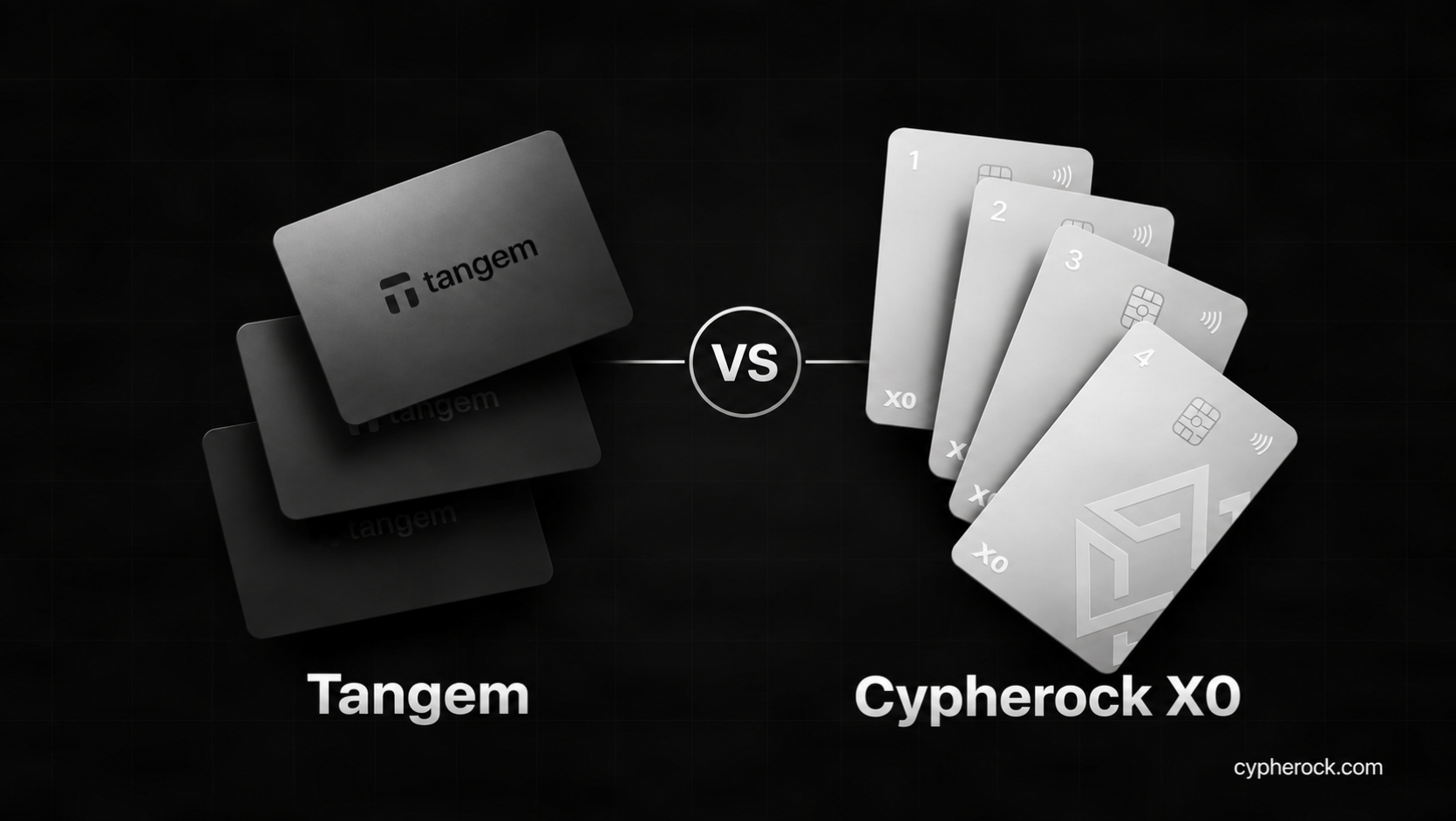
Tangem vs Cypherock X0: Which Card-Based Hardware Wallet Offers Better Security?
Card-based hardware wallets have transformed crypto self-custody.
Instead of carrying USB devices or writing down long recovery phrases, users can simply tap a card against their phone to manage digital assets.
Two names dominate this category today:
Tangem
Cypherock X0
Both wallets offer a mobile-first experience, NFC cards, and an intuitive onboarding process. But beneath the surface, they follow fundamentally different security architectures.
The difference isn't about user interface.
It's about where your private key exists.
Let's take a closer look.
Quick Comparison
Feature | Tangem | Cypherock X0 |
|---|---|---|
Mobile-first | ✅ | ✅ |
NFC Cards | 2 or 3 | 4 |
Eliminates seed phrase vulnerability | ✅ | ✅ |
Secure Element | EAL6+ | EAL6+ |
Private key sharding | ❌ | ✅ |
Shamir Secret Sharing | ❌ | ✅ |
Card-side computation | Limited to key storage/signing | ✅ Full wallet reconstruction & signing |
Daily usage | Phone + any Tangem card | Phone + any X0 card |
Recovery | Backup cards containing identical private keys | Any two cards reconstruct wallet |
Single point of failure | Private key exists in full on every backup card | No single device ever stores the complete wallet |
Similarities
Both wallets share several strengths.
They are designed to eliminate USB cables and desktop software while making self-custody approachable for everyday users.
Both offer:
Mobile-first experience
NFC tap-to-use workflow
EAL6+ certified Secure Elements
Support for major blockchains
Easy onboarding
If you're moving away from exchange custody, both products are significantly more secure than leaving assets on a centralised exchange.
The biggest differences emerge once we look at how each wallet protects private keys.
Tangem's Security Model
Tangem generates your private key inside its Secure Element.
That key never leaves the chip in plaintext, which is an important security property.
To create backups, Tangem securely clones the same private key onto one or two additional Tangem cards.
If you purchase a three-card set, all three cards contain identical copies of the wallet's private key. Tangem's official documentation states that the backup devices are equivalent and each contains the same wallet.
This provides excellent redundancy.
Lose one card? Use another.
Lose two cards? The remaining card still gives access.
For most users, this is an intuitive and convenient recovery model
Cypherock X0 Takes a Different Approach
Instead of copying one private key onto multiple cards, X0 ensures that no single device ever stores the complete wallet.
During wallet creation:
The master seed is generated inside the Secure Element.
It is split into five cryptographic shards using Shamir Secret Sharing.
Four shards are stored across four NFC cards.
The fifth shard is encrypted and stored securely on your phone.
The original master seed is permanently deleted.
From that moment onward, the complete wallet exists only temporarily during transaction signing, inside the Secure Element of the tapped card.
Clone vs Split
This is the biggest architectural difference between the two wallets.
Tangem
Every backup card stores the same private key.
Think of it as making multiple identical copies of a house key.
If one key works, every other key works too.
Cypherock X0
There are no copies.
Instead, the wallet is mathematically divided into five shards using Shamir Secret Sharing.
Each shard is individually useless.
Only when sufficient shards come together can the wallet be reconstructed.
It isn't duplication.
It's cryptographic distribution.
Where Does Transaction Signing Happen?
This is another major distinction.
Tangem
Tangem performs signing within the Secure Element using the private key stored on that card. Each backup card contains a full copy of the wallet, so any card can independently authorise transactions.
Cypherock X0
X0 follows a different flow.
When you tap a card:
The phone securely sends its encrypted shard and the unsigned transaction hash.
The card reconstructs the wallet inside its Secure Element.
The private key is derived.
The transaction is signed.
Every temporary secret is erased.
Only the signed transaction leaves the Secure Element.
Daily Experience
Both wallets are remarkably simple.
Tangem
Open app
Tap any card
Approve transaction
Cypherock X0
Open app
Tap any card
Approve transaction
For everyday users, the experience feels almost identical.
The complexity lies entirely behind the scenes.
Recovery Experience
Tangem
Recovery is straightforward.
As long as you possess one of your backup cards, you retain access because every backup contains the complete wallet.
Cypherock X0
Recovery follows a threshold model.
If your phone is lost:
Install cySync Mobile
Tap any two X0 cards
The wallet is reconstructed securely
A new phone shard is generated
All cards receive updated shards
Recovery never requires exposing a seed phrase.
How Each Wallet Handles Device Compromise
Consider a hypothetical scenario where an attacker gains physical access to one card.
Tangem
That card already contains the complete wallet's private key inside its Secure Element. Tangem relies on the security of the Secure Element and the access controls around the card to protect that key.
Cypherock X0
One X0 card contains only a single shard.
That shard alone cannot reconstruct the wallet or reveal any usable private key.
Even if an attacker somehow extracted it, it provides no access without another required shard.
The Smartphone's Role
Both products are mobile-first, but they trust the smartphone differently.
Tangem
The phone serves as the interface to the wallet while cryptographic operations remain protected by the card's Secure Element.
Cypherock X0
The phone is deliberately limited.
It only:
Stores one encrypted shard
Builds transactions
Relays encrypted data
Broadcasts signed transaction hash
It never reconstructs the wallet.
It never derives private keys.
It never performs cryptographic operations on key material.
Security Philosophy
The real difference between the two wallets comes down to philosophy.
Tangem focuses on simplicity through secure duplication.
Cypherock focuses on eliminating single points of failure through cryptographic distribution.
Both approaches use certified Secure Elements.
Both protect keys from software attacks.
But they answer one question differently: should a complete private key ever exist permanently on a single device?
Tangem answers yes, inside each authenticated backup card.
Cypherock X0 answers no. Instead, it ensures no single device ever permanently stores the complete wallet. Cypherock X0's architecture has been independently audited by Keylabs and Wallet Scrutiny, validating the integrity of its distributed key model.
Which Wallet Is Right for You?
If your priority is the simplest possible recovery model, Tangem offers a polished mobile experience with backup cards that each provide full access to your wallet.
If your priority is minimising single points of failure, Cypherock X0 takes a different architectural path by distributing trust across multiple cryptographic shards and ensuring sensitive operations happen inside an EAL6+ Secure Element without any device permanently storing the full wallet.
Ultimately, both wallets represent a significant improvement over software wallets or leaving assets on exchanges. The choice comes down to the security model you prefer: replicated keys for simplicity, or distributed shards for eliminating single-device trust.