How Does Cypherock X0 Work? A Deep Dive Into Card-Side Computation
Hardware wallets have traditionally followed a simple idea: keep your private keys away from your computer or phone.
But as crypto becomes increasingly mobile-first, another question becomes important:
What if your phone could give you the convenience of a mobile wallet without ever getting access to your private key?
That is the idea behind Cypherock X0.
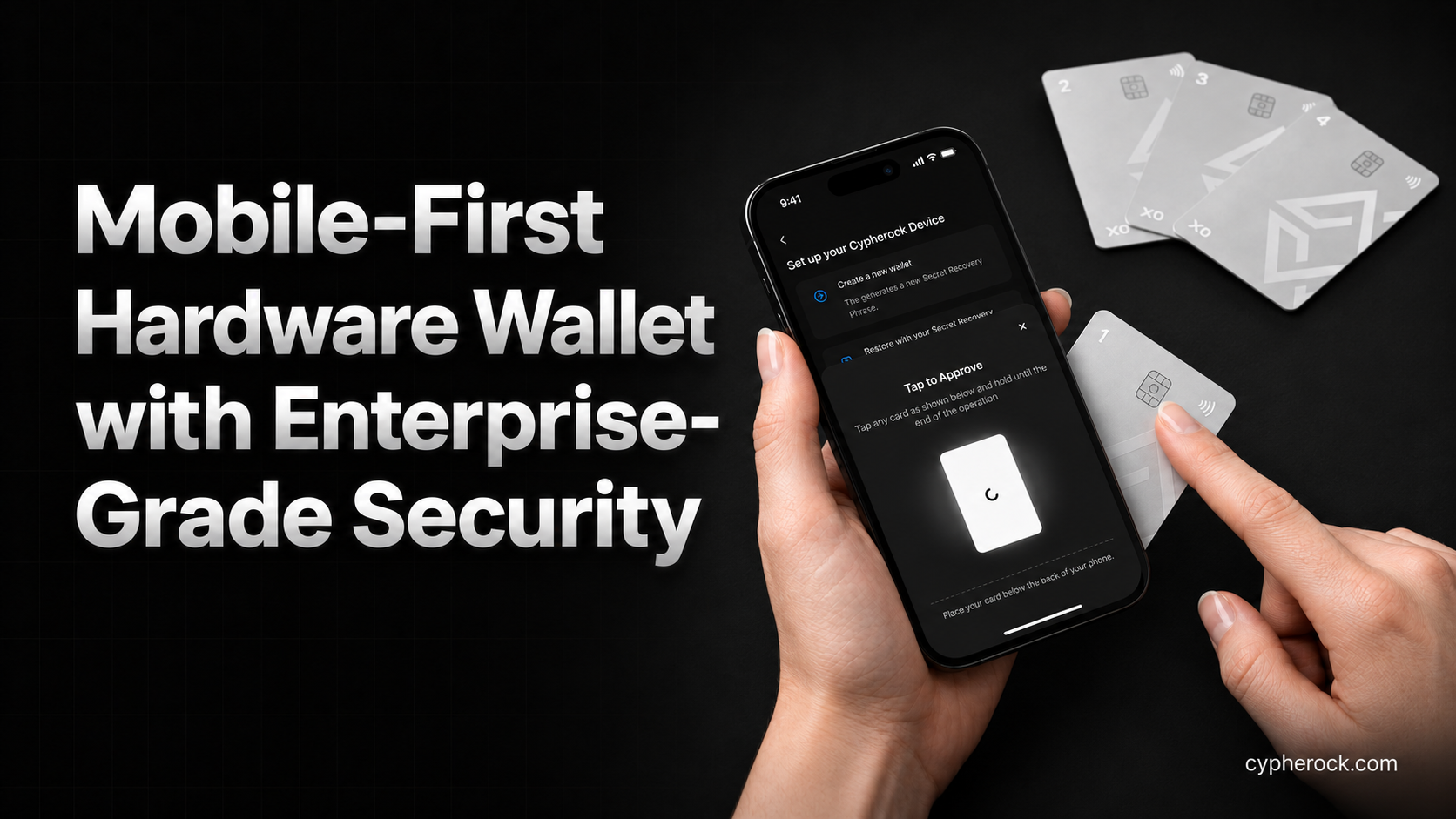
X0 combines Cypherock's Shamir Secret Sharing architecture with four NFC cards and a mobile app. Instead of using a separate hardware vault like the Cypherock X1, X0 uses your smartphone as the interface while moving the critical cryptographic computation directly onto the secure element inside the cards.
The result is a fundamentally different architecture:
Your phone manages the experience. Your cards protect and process the key.
What Is Cypherock X0?
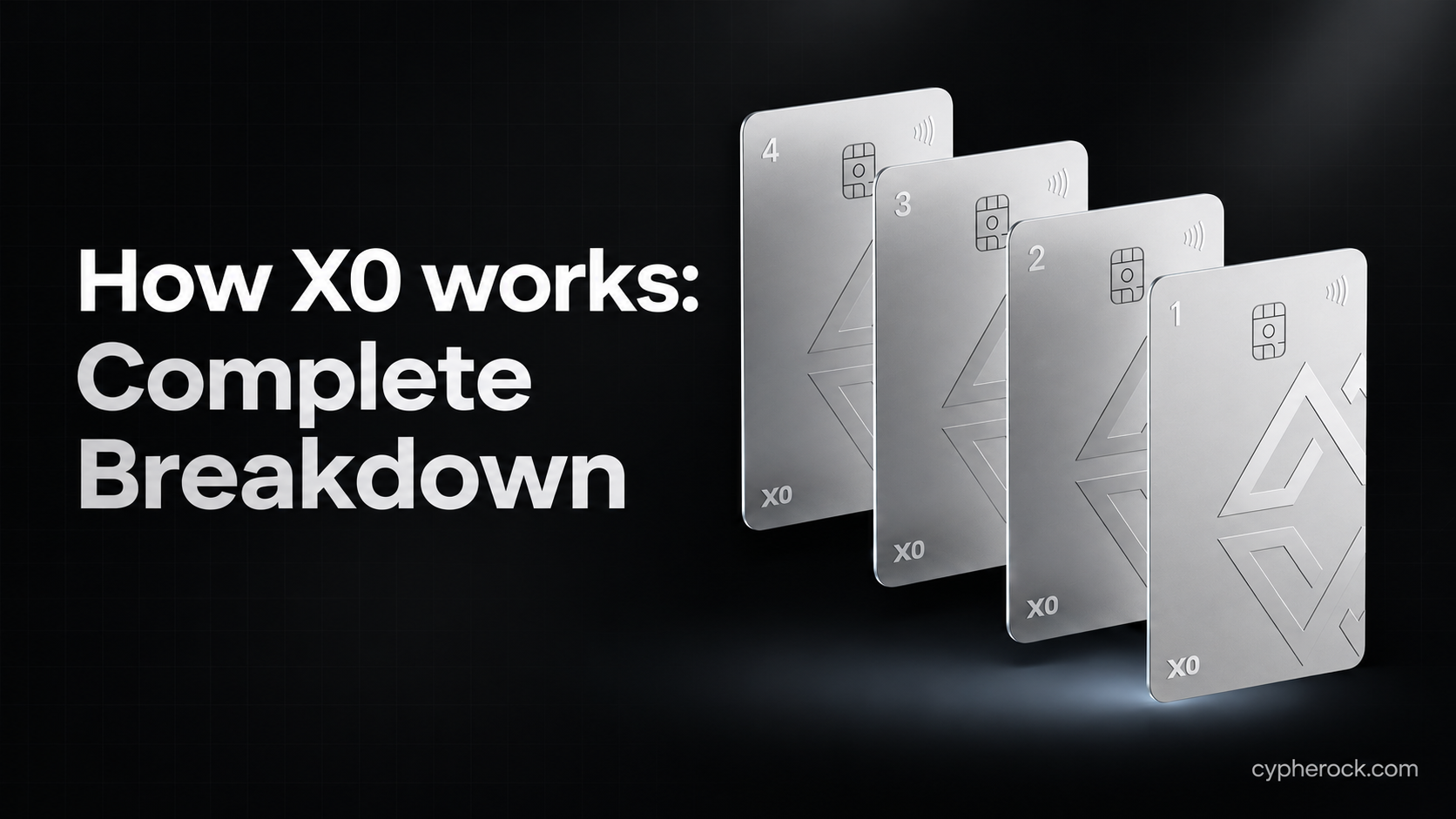
Cypherock X0 is a mobile-first hardware wallet built around four NFC smart cards and the cySync Mobile app.
The four cards contain individual cryptographic shards rather than copies of your private key. A fifth shard is securely stored on your smartphone.
X0 uses a 2-of-5 Shamir Secret Sharing (SSS) architecture. This means that any two of the five shards are sufficient to reconstruct the wallet, while a single shard by itself reveals nothing about the underlying secret.
The five shards are distributed as follows:
Card 1 → Shard 1
Card 2 → Shard 2
Card 3 → Shard 3
Card 4 → Shard 4
Phone → Shard 5
Importantly, these aren't five copies of your private key. They are cryptographic shares of the underlying secret.
And this distinction is at the heart of how X0 works.
The Most Important Part: Your Phone Never Gets Your Private Key
The cySync Mobile app is designed to handle the wallet experience: displaying your portfolio, creating transactions, showing addresses and communicating with the blockchain.
But it does not perform cryptographic operations on your private key.
The phone stores the fifth shard in its hardware-backed secure storage, such as the iOS Secure Element or Android TEE/StrongBox. When a transaction needs to be signed, the phone simply acts as a secure courier, passing the encrypted shard to an X0 card over NFC.
The actual cryptographic work happens inside the card's EAL6+ secure element.
This includes:
Reconstructing the secret
Deriving the required private key
Signing the transaction
Erasing sensitive key material from volatile memory
The phone receives only the resulting signed transaction.
The private key is never exposed to the phone.
How Does X0 Create Your Wallet?
Let's walk through what happens when you set up X0 for the first time.
Step 1: Set Up cySync Mobile
You download the cySync Mobile app and enable app security using biometrics or a PIN.
This initializes the phone's hardware-backed secure storage, where the fifth shard will eventually be stored.
Step 2: Tap the First X0 Card
You bring the first X0 card close to your smartphone.
The card and app authenticate each other through a challenge-response mechanism before sensitive operations can take place.
Step 3: Generate the Wallet
The wallet's master seed is generated inside the secure element of the card.
The card's secure element generates entropy using its hardware random number generator, supplemented by entropy supplied by the phone.
The master seed is then generated inside the secure element and split using Shamir Secret Sharing into five shards.
At this point, the complete secret is never handed to the phone.
Step 4: Distribute the Five Shards
The first card keeps one shard.
The remaining shards are securely distributed:
Three shards go to Cards 2, 3 and 4.
One shard goes to the phone's secure storage.
The phone can act as an encrypted relay when distributing shards between cards, but the sensitive shard transfers are protected by encrypted communication between the cards.
Once setup is complete, the complete master secret no longer exists as a persistent object.
Instead, it has been divided across the five locations.
Why Five Shards?
This is where Shamir Secret Sharing makes X0 different from a conventional single-key hardware wallet.
X0 uses a 2-of-5 threshold.
That means:
Any 2 of the 5 shards can recover the wallet.
But:
1 shard alone cannot recover the wallet.
This creates redundancy without creating five copies of the private key.
For everyday transactions, you use:
Phone + any one X0 card
The phone supplies shard 5, while the card supplies its own shard. Together, they provide the two shares required for the card to reconstruct the secret internally.
This also means losing one card doesn't automatically mean losing access to your wallet.
You can lose multiple individual shards and still retain the ability to recover, provided you retain at least two valid shards.
What Happens When You Receive Crypto?
Receiving crypto doesn't require signing a transaction.
When you want to receive an asset, you select the wallet, asset and network inside cySync Mobile and tap an X0 card.
The card derives the appropriate public address internally and returns only the address to the app.
The app can then display the address as text or a QR code for you to share.
The important distinction is that the sensitive private key remains inside the secure element.
What Happens When You Send Crypto?
This is where X0's card-side computation really matters.
Imagine you want to send Bitcoin, Ethereum or another supported asset.
1. You Create the Transaction
Inside cySync Mobile, you enter:
Recipient address
Amount
Network
Transaction fee
The app prepares the unsigned transaction and presents it for your review.
2. You Approve Access to the Phone's Shard
The phone's secure storage releases shard 5 after the required authentication, such as biometric verification.
3. Tap an X0 Card
You tap any one of your X0 cards against your phone.
The phone establishes an encrypted NFC session with the card.
It sends the card:
The encrypted fifth shard
The unsigned transaction
The relevant derivation information
It does not send a private key because the phone doesn't have one.
4. The Card Reconstructs the Secret
Inside the card's secure element, the card combines:
Its own shard + the phone's shard
The secret is reconstructed inside the secure element's protected environment.
The phone never sees the reconstructed secret.
5. The Card Derives the Private Key
The secure element derives the required private key from the reconstructed secret using the appropriate derivation path.
Again, this happens inside the card.
6. The Card Signs the Transaction
The transaction is signed inside the card's secure element.
The private key does not leave the secure element.
7. Sensitive Data Is Erased
After signing, the card zeros the reconstructed secret, derived private key and received phone shard from volatile memory.
Only the card's own persistent shard remains.
8. Only the Signed Transaction Leaves the Card
The card sends the signed transaction bytes back to the mobile app.
The app then broadcasts the signed transaction hash to the blockchain.
So the complete flow is:
Phone → encrypted shard + unsigned transaction → X0 Card → cryptographic computation → signed transaction → Phone → Blockchain
At no point does the phone receive the private key.
Why Is the Computation Done on the Card?
This is one of the most important design decisions behind X0.
Modern smartphones have powerful security hardware, but Android devices vary significantly across manufacturers and models. Their trusted execution environments, operating systems and security implementations are not identical.
X0 therefore avoids making the phone responsible for signing.
Instead, the secure element inside every X0 card provides a consistent hardware environment for the most sensitive operations.
The X0 card uses an ATECC608C EAL6+ certified secure element, which is responsible for shard storage, secret reconstruction, key derivation, transaction signing and key zeroing.
This creates a simple security boundary:
The phone can be compromised without gaining access to the complete private key.
Even if an attacker were able to obtain the phone's shard, that shard alone is insufficient to reconstruct the wallet.
What Exactly Does the Phone Do?
The phone is important, but its role is deliberately limited.
The cySync Mobile app handles:
Portfolio management
Transaction creation
Blockchain queries
Address display
QR codes
NFC communication
WalletConnect
Transaction broadcasting
Wallet settings
But it doesn't reconstruct the private key or sign transactions.
The phone functions as a shard courier and UI surface.
That distinction is fundamental to X0.
Your smartphone provides the convenience of a mobile wallet.
Your X0 card provides the hardware security layer.
How Secure Is the NFC Communication?
NFC is used as the communication layer between your phone and X0 cards.
X0 uses an encrypted communication protocol designed to prevent sensitive information from being exposed during the NFC exchange.
The architecture uses:
NFC-A at 13.56 MHz
ISO 14443-A
ISO 7816-4 APDUs
Mutual authentication
ECDH-based session establishment
AES-256-GCM encryption
During signing, the phone sends the encrypted shard and unsigned transaction to the card, while the card sends back only the signed transaction bytes.
This means an NFC interception does not simply expose the shard in plaintext.
What If Someone Steals Your Phone?
A stolen phone does not automatically give an attacker your wallet.
The phone contains only one of the five shards.
And because X0 uses a 2-of-5 threshold, one shard alone isn't enough to reconstruct the wallet.
The phone's shard is also stored in hardware-backed secure storage and protected by biometric or PIN authentication.
Most importantly, the phone doesn't contain the private key itself.
The card is still required for signing.
What If Someone Steals One X0 Card?
The same principle applies.
A single card contains only one shard.
That shard alone doesn't reveal the wallet secret.
Additionally, the card is protected with optional PIN protection and progressive CyLock lockout mechanisms.
And because the card requires the phone's shard to perform everyday signing, simply possessing one card isn't enough to sign transactions.
What If Your Phone Is Hacked?
This is one of the key advantages of card-side computation.
A compromised phone may potentially expose the phone-held shard, but that shard by itself cannot reconstruct the wallet.
More importantly, the phone cannot independently sign a transaction because the signing engine lives inside the X0 card's secure element.
The attacker still needs the required card-side shard and the ability to interact with the secure element.
This is why X0 separates transaction creation from transaction signing.
The phone can prepare the transaction.
The card has the authority to sign it.
What If You Lose a Card?
X0 is designed around redundancy.
Because the wallet uses five shards with a 2-of-5 threshold, you don't need every card to recover the wallet.
For example, if you lose one or more cards but still have two valid shards, the wallet can be recovered.
For normal everyday transactions, however, the simplest setup is:
Your phone + any one X0 card.
Cypherock recommends storing the four cards in separate locations, so losing one physical location doesn't necessarily compromise access to the wallet.
How Does Wallet Recovery Work?
Recovery is also built around the 2-of-5 architecture.
Suppose you lose your phone.
You can install cySync Mobile on a new phone and select Restore Wallet.
You then tap any two X0 cards.
One card receives the second card's shard through the encrypted relay provided by the phone.
The card reconstructs the wallet inside its secure element.
It then generates a new fifth shard and securely transfers that shard to the new phone's hardware-backed storage.
The cards can subsequently be re-sharded, and the old phone's shard is invalidated.
The important point is that recovery doesn't require reconstructing the private key on your new phone.
The recovery operation happens inside the card's secure element.
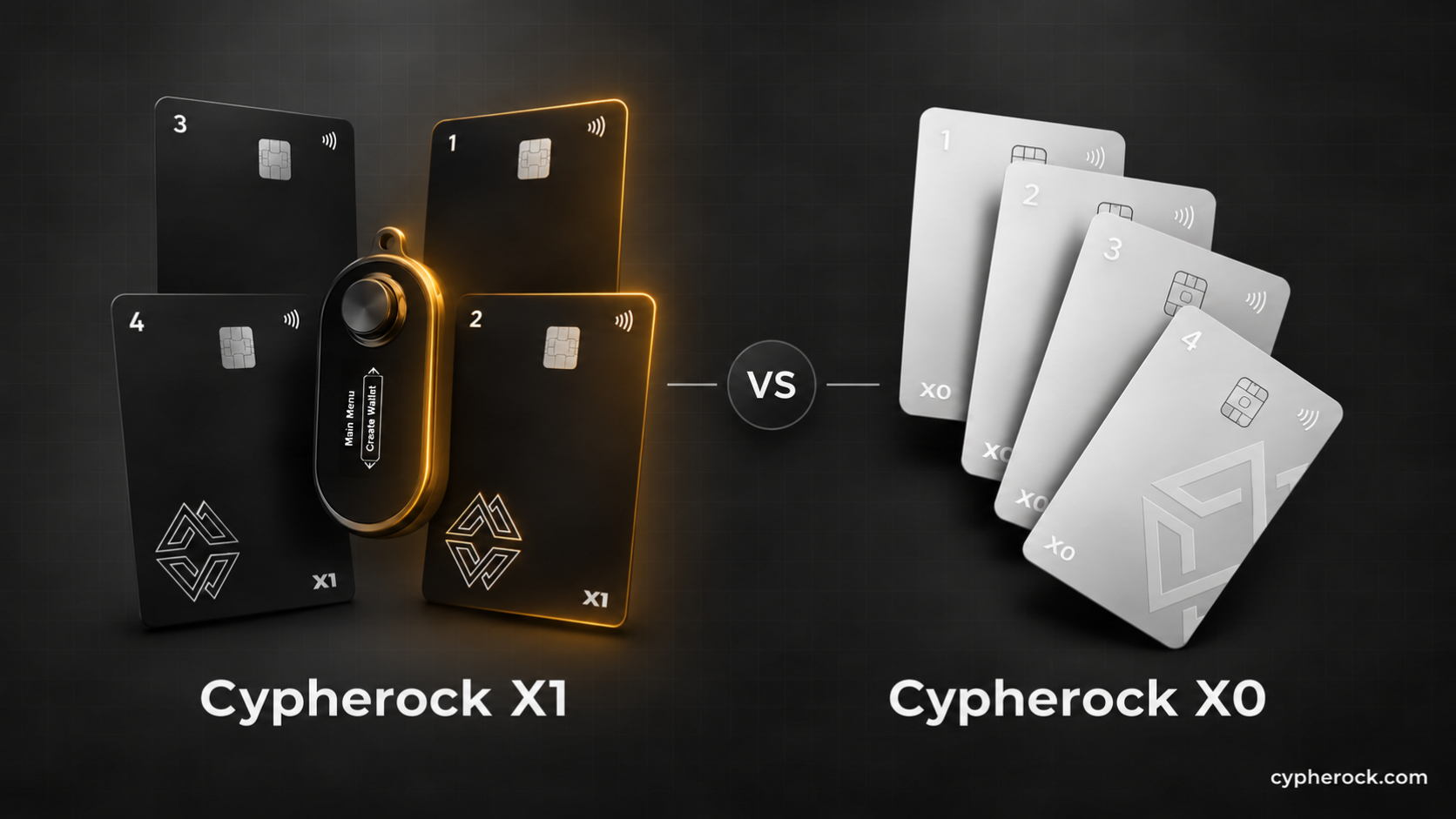
X0 vs X1: What's Different?
Cypherock X0 and X1 share the same fundamental idea: Shamir Secret Sharing rather than a single private-key backup.
The architectural difference is where the cryptographic computation takes place.
With Cypherock X1, the Vault handles the critical cryptographic operations.
With Cypherock X0, those operations move directly into the secure element inside the X0 card.
This allows X0 to eliminate the dedicated Vault and make the experience entirely mobile-first.
So the basic architecture becomes:
Cypherock X1: Vault + 4 Cards + Desktop
Cypherock X0: 4 Cards + Smartphone
The X0 cards are hardware-identical to the X1 cards, but their firmware adds the SSS reconstruction and signing engine that would normally reside in the X1 Vault.
Multi-Chain Support
X0 is designed to support a broad range of blockchain assets.
The current X0 catalog covers 15 networks and approximately 22,900+ coins and tokens, including Bitcoin-family networks, EVM networks, Tron and XRP Ledger.
The currently included networks are:
Bitcoin-family: Bitcoin, Litecoin, Dogecoin and Dash
EVM: Ethereum, Polygon, BNB Smart Chain, Fantom Opera, Avalanche C-Chain, Optimism, Arbitrum One, Hyperliquid and Base
Other: Tron and XRP Ledger
Some networks are currently excluded because they use cryptographic curves that the current X0 card architecture does not support. These include Solana, NEAR, Starknet, Internet Computer, Stellar, Sia and Canton.
More networks are planned to follow in the future, expanding X0's coverage over time.
The Core Idea Behind X0
The easiest way to understand Cypherock X0 is to think of it as separating your wallet into three jobs.
Your Phone
The interface
It displays your portfolio, creates transactions and communicates with blockchains.
Your X0 Cards
The security layer
They store shards and perform the sensitive cryptographic operations.
The Blockchain
The settlement layer
It receives the final signed transaction and records it on-chain.
The phone doesn't need to be trusted with your private key because it never has your private key.
Why X0's Architecture Matters
Traditional mobile wallets prioritize convenience.
Traditional hardware wallets prioritize keeping keys away from connected devices.
X0 takes a different approach.
It asks:
What if you could keep the convenience of your smartphone while moving the most sensitive computation into dedicated hardware?
That's what card-side computation is designed to achieve.
The phone becomes the interface.
The cards become the cryptographic engine.
And Shamir Secret Sharing ensures that no single card, or the phone alone, contains enough information to reconstruct the wallet.
Cypherock X0's architecture has been independently audited by third-party security researchers, validating the integrity of its distributed key model and card-side computation approach.
In other words:
Your phone doesn't hold your private key. Your cards don't hold copies of your private key. And your private key doesn't need to leave the secure element.
That's the architecture behind Cypherock X0.