How Cypherock X0 Works: Bringing Enterprise-Grade Security to a Mobile-First Hardware Wallet
When Cypherock launched the X1 hardware wallet in 2022, it introduced a fundamentally different way of protecting crypto. Instead of exposing seed phrases to the user, X1 used Shamir's Secret Sharing (SSS) to split wallet secrets across multiple hardware components, eliminating the seed phrase vulnerability that defines most hardware wallets. The architecture was independently audited by Keylabs and Wallet Scrutiny, helping establish Cypherock as one of the most security-focused hardware wallet manufacturers.
With Cypherock X0, we're taking that same security philosophy and making it accessible to millions of mobile-first users around the world.
Instead of replacing security with convenience, X0 replaces the dedicated Vault with something every crypto user already owns, a smartphone, while ensuring that the phone never becomes the trusted device.
Here's exactly how it works.
The X0 Architecture
X0 consists of just two components:
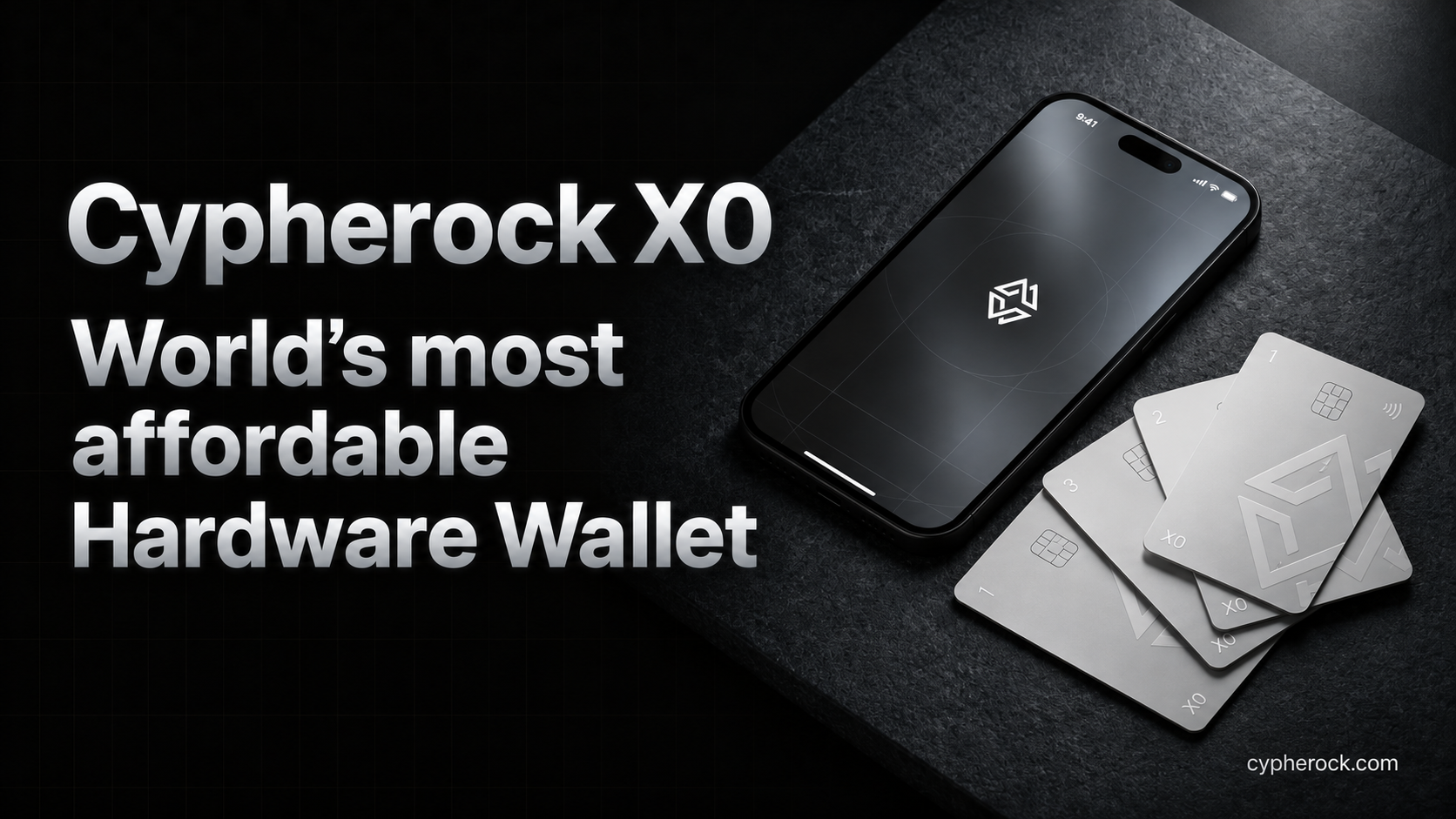
4 NFC smart cards
cySync Mobile App
Unlike traditional wallets, the smartphone is not where private keys live.
Instead, the phone simply provides:
Portfolio management
Transaction creation
Blockchain communication
Encrypted storage of one cryptographic shard
Every security-sensitive operation happens somewhere else.
Inside the card.
Step 1: Creating Your Wallet
The first time you set up X0, you install the cySync Mobile app and tap your first X0 card.
At this moment, something unique happens.
Instead of generating your wallet on your phone, the secure element inside Card 1 generates the wallet completely offline.
The card:
Generates high-quality entropy
Creates your BIP-39 master seed
Splits it using Shamir Secret Sharing (2-of-5)
Keeps one shard inside itself
The remaining shards are then distributed securely:
Card 2 receives shard 2
Card 3 receives shard 3
Card 4 receives shard 4
Your phone securely stores shard 5 inside its Secure Element (iOS) or TEE/StrongBox (Android)
Once distribution is complete, the original master seed is permanently deleted.
Only the individual shards remain.
Why Split the Wallet?
Traditional hardware wallets typically store an entire private key in one place.
That creates a single point of failure.
X0 doesn't.
Your wallet is divided into five cryptographic shards using Shamir Secret Sharing.
This means:
One shard alone reveals nothing.
Any two valid shards can reconstruct the wallet.
Losing multiple cards doesn't necessarily mean losing your assets.
For daily use, X0 only needs:
Your phone
Any one of your four cards
For recovery, any two cards are sufficient to rebuild the wallet and generate a new phone shard.
Step 2: Sending Crypto
Suppose you want to send Bitcoin, Ethereum, or any supported asset.
Here's what happens.
Inside the app, you enter:
Recipient address
Amount
Network fee
The app builds an unsigned transaction.
At this point, nothing has been signed.
No private keys have been used.
The app simply waits for your card.
Step 3: Tap Any Card
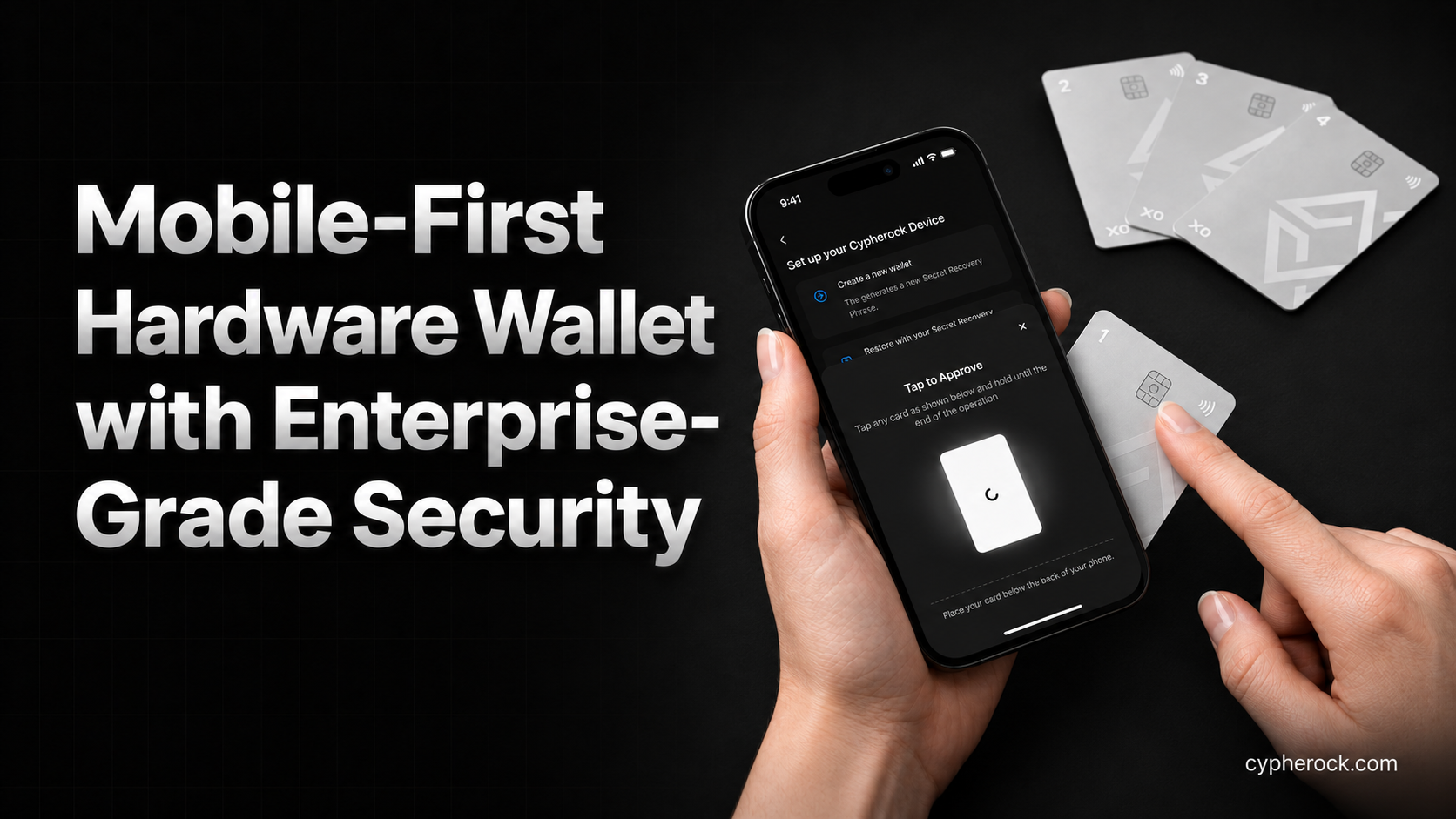
Now you tap any one of your four X0 cards.
The phone retrieves its encrypted shard from the Secure Element or TEE after biometric authentication.
The app then securely sends two things to the card over an encrypted NFC channel:
Phone shard (Shard 5)
Unsigned transaction
That's it.
The phone does not reconstruct the wallet.
It does not derive private keys.
It does not sign anything.
It simply relays encrypted information to the card.
Step 4: Everything Happens Inside the Card
This is where X0 becomes fundamentally different.
Inside the card's EAL6+ certified Secure Element, the card:
Combines its own shard with the phone's shard.
Reconstructs the master seed.
Derives the required private key.
Signs the transaction.
Immediately wipes every temporary secret from memory.
The reconstructed seed never leaves the Secure Element.
The private key never leaves the Secure Element.
After signing, the card sends back only one thing:
The signed transaction.
Nothing else.
Step 5: Broadcast to the Blockchain
Once the app receives the signed transaction, it broadcasts it to the blockchain.
The phone never possessed:
The master seed
The reconstructed wallet
The derived private key
It simply acted as a messenger.
This separation dramatically reduces the attack surface compared to wallets that perform signing on a mobile device.
What Happens If You Lose Your Phone?
Losing your phone doesn't mean losing your crypto.
Simply install cySync Mobile on a new phone.
Then:
Tap any two X0 cards
The cards reconstruct the wallet securely
A brand-new phone shard is generated
Your new phone receives the new shard
Recovery never requires exposing your private key.
Why the Phone Isn't Trusted
Many mobile-first wallets depend heavily on the phone.
X0 deliberately avoids that.
The phone stores only one encrypted shard inside hardware-backed secure storage.
It never:
Generates private keys
Reconstructs the wallet
Signs transactions
Performs cryptographic operations on key material
Even if the phone is compromised, the attacker gains only one encrypted shard, which is useless without a card and the PIN.
Why Card-Side Computation Matters
The biggest innovation in X0 isn't the cards.
It's where computation happens.
Instead of trusting thousands of different Android devices and smartphone manufacturers to securely perform signing, X0 moves every cryptographic operation into the card's Secure Element.
Every X0 card contains the same certified hardware regardless of whether you're using:
an entry-level Android phone,
a flagship device,
or an iPhone.
The security model stays consistent because the phone never becomes the root of trust.
This approach preserves the security philosophy introduced with X1 while making the experience fully mobile-first.
Security Without the Complexity
From the outside, using X0 feels incredibly simple.
Open the app.
Create a transaction.
Tap a card.
Done.
Behind that simple experience, however, the wallet performs sophisticated cryptographic operations that remain invisible to the user:
Wallet generation
Shamir Secret Sharing
Secure shard distribution
Key reconstruction
Private key derivation
Transaction signing
Secure memory zeroing
All without exposing your private keys to your phone.
The Future of Mobile Hardware Wallets
Cypherock X1 proved that seed phrase vulnerability doesn't have to define hardware wallet security. By combining Shamir Secret Sharing with secure hardware, it demonstrated a more resilient architecture that was independently audited by Keylabs and Wallet Scrutiny.
X0 builds on that foundation, reimagining it for a world where most crypto users live on their phones. Rather than compromising on security for convenience, it keeps the same core principle intact: all sensitive cryptographic operations remain inside certified secure hardware.
The result is a hardware wallet designed for the next generation of crypto users, mobile-first, easy to use, and built around the idea that your private keys should never leave the Secure Element.