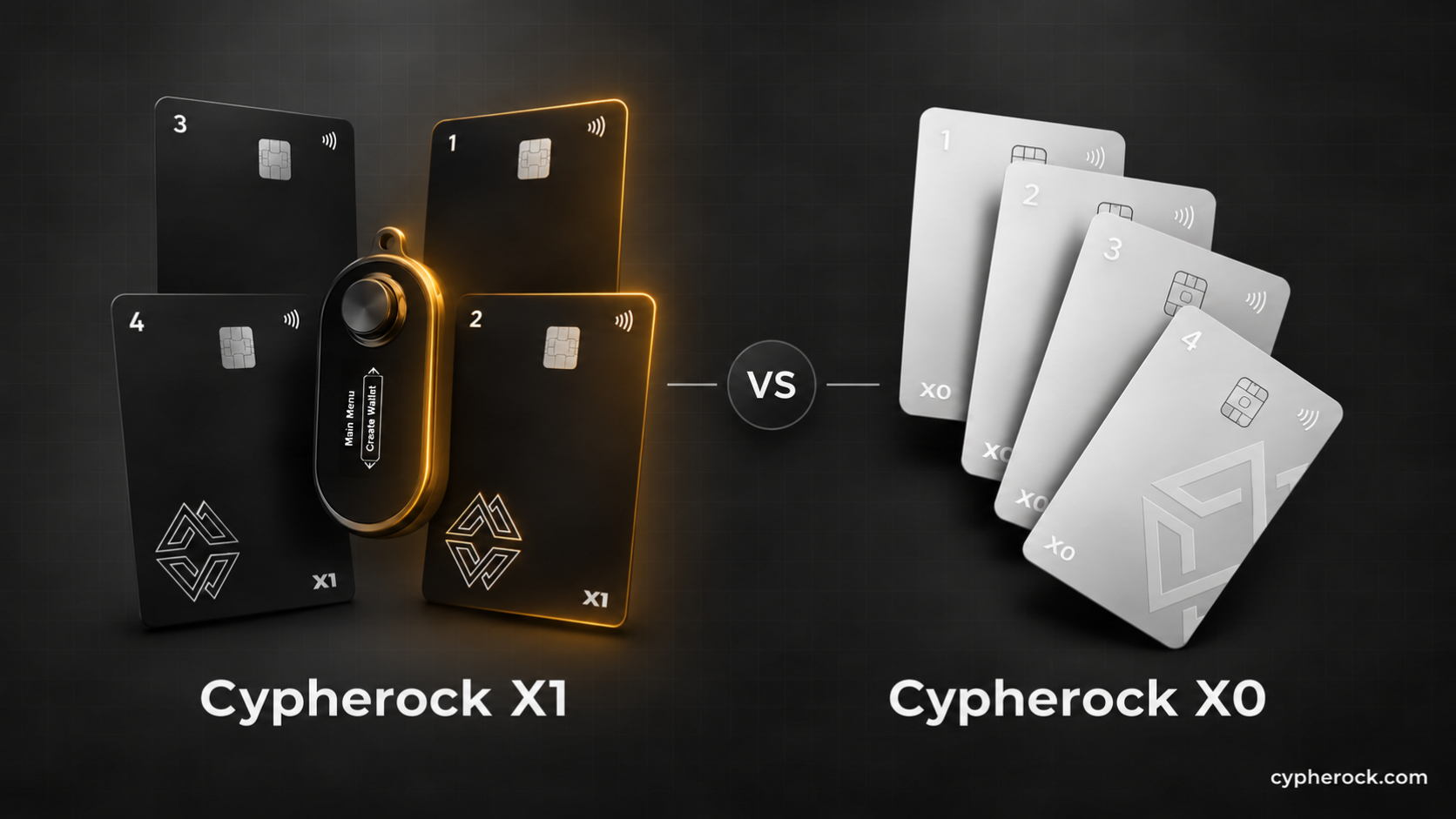
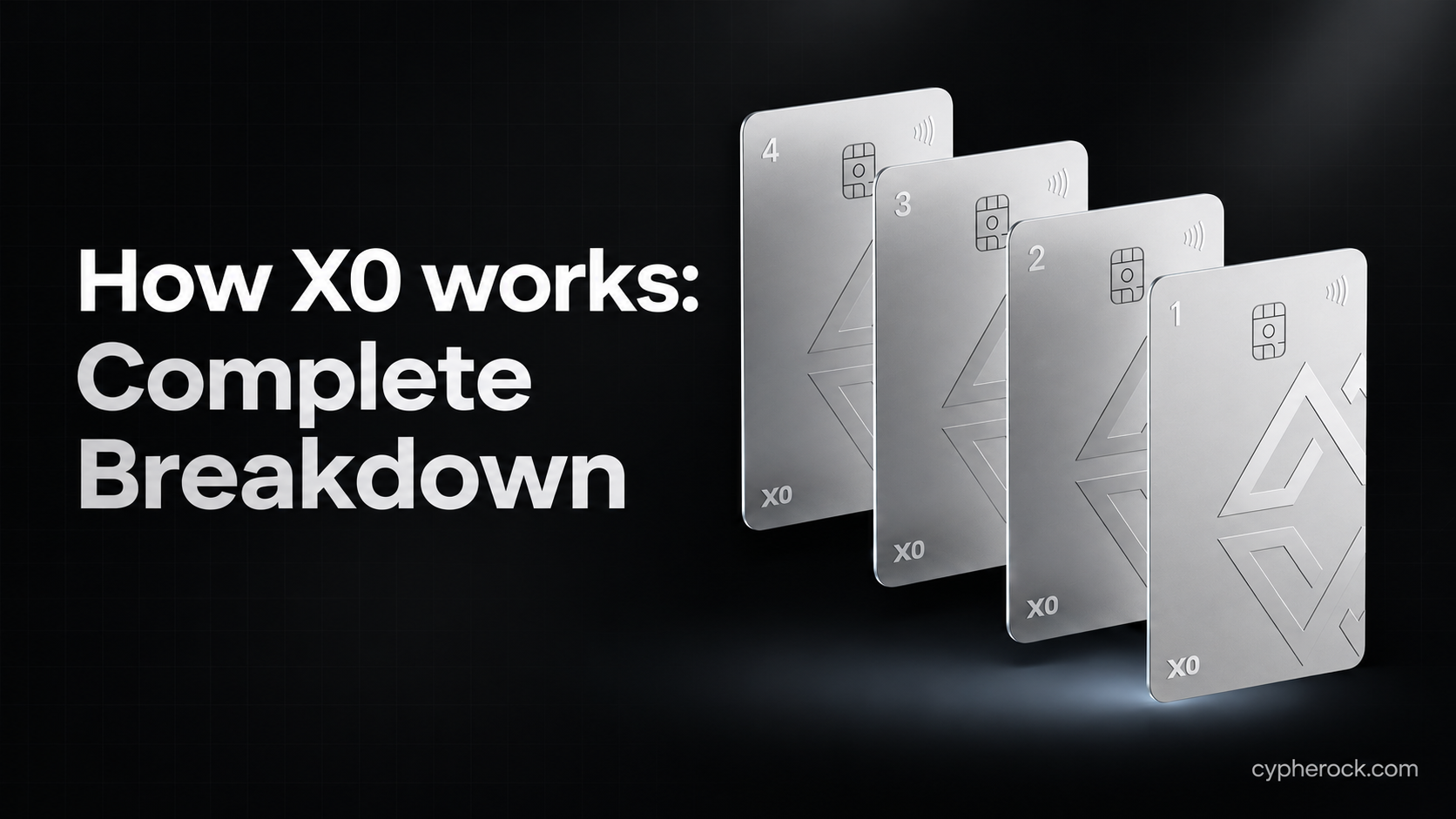
Tangem vs Cypherock X0 vs Ledger vs Trezor: Which Hardware Wallet Should You Choose in 2026?
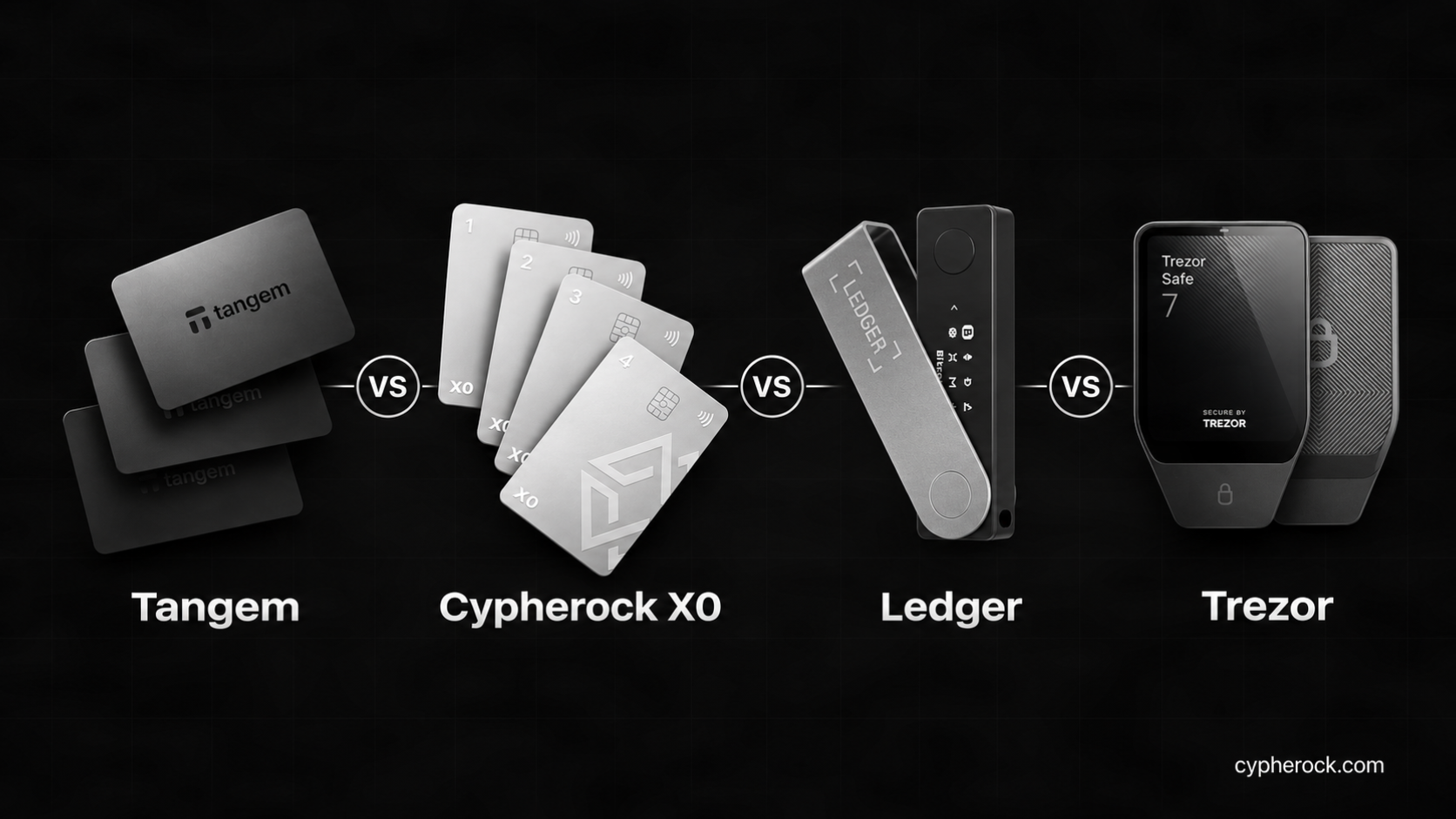
The hardware wallet market has never been stronger.
Whether you're buying your first cold wallet or upgrading from an existing one, four names consistently appear at the top of the list:
Cypherock X0
Tangem
Ledger
Trezor
All four wallets keep your private keys offline.
All four are significantly safer than software wallets or leaving crypto on exchanges.
But they approach security very differently.
Some prioritize simplicity.
Some prioritize verification.
Some prioritize openness.
And some rethink how private keys should be stored altogether.
Let's compare them.
Quick Comparison
Feature | Cypherock X0 | Tangem | Ledger | Trezor |
|---|---|---|---|---|
Mobile-first | ✅ | ✅ | Partial | Partial |
Dedicated hardware device | 4 NFC Cards | 2–3 NFC Cards | Yes | Yes |
Trusted screen | ❌ (phone UI) | ❌ | ✅ | ✅ |
Secure Element | EAL6+ | EAL6+ | Yes (EAL5+/EAL6+, model dependent) | Varies by model |
Eliminates seed phrase vulnerability | ✅ | ✅ | ❌ | ❌ |
Shamir Secret Sharing | ✅ | ❌ | ❌ | Optional on supported models |
Private key distribution | ✅ | ❌ | ❌ | ❌ |
Card-side computation | ✅ | Signs on card | ❌ | ❌ |
Daily usage | Phone + 1 card | Phone + 1 card | Device | Device |
Recovery | Any 2 cards | Backup cards | Seed phrase | Seed phrase |
Four Different Security Philosophies
Every hardware wallet answers one fundamental question differently: where should your private key live?
Ledger
One hardware wallet
One Secure Element.
One private key.
Recovery depends on a 24-word seed phrase.
Trezor
One hardware wallet.
One private key.
Recovery also depends on a seed phrase, with optional Shamir-based backups on supported models. Trezor emphasizes openness and auditability of its software and hardware designs.
Tangem
One private key.
Cloned securely onto multiple NFC cards.
Every card can independently access the wallet.
Cypherock X0
No complete wallet is permanently stored anywhere.
Instead, the wallet is split into five cryptographic shards using Shamir Secret Sharing.
Only temporary reconstruction occurs during signing, inside an EAL6+ Secure Element.
1. Ease of Use
Tangem
Tangem scores high when it comes to ease of use and is a card and mobile based wallet similar to Cypherock X0.
Setup takes only a few minutes.
Open the app. Tap the card. Done.
No cables. No buttons. No desktop.
Its simplicity has made it especially popular among beginners.
Cypherock X0
Cypherock X0 delivers a similarly streamlined experience and scores high on ease of use for crypto users.
Open the app. Create a transaction. Tap any X0 card.
Behind the scenes, advanced cryptography is happening, but the user experience remains simple and mobile-first.
Ledger
Ledger offers polished software and broad ecosystem support, but daily use involves interacting with a dedicated device using buttons or a touchscreen, depending on the model.
Trezor
Trezor provides an intuitive experience, particularly on touchscreen models, though its desktop-first workflow feels more traditional than NFC-based wallets.
2. Security Architecture
This is where the wallets begin to diverge.
Ledger
Ledger stores your complete private key inside a Secure Element.
The device signs transactions internally and displays transaction details on its own screen for independent verification.
Trezor
Trezor also stores the wallet on the hardware device, with recovery based on a seed phrase. Its defining characteristic is its open-source philosophy and transparent design.
Tangem
Tangem stores the same private key on each backup card.
Every card can independently sign transactions.
This creates excellent redundancy while maintaining a very simple user experience.
Cypherock X0
Cypherock takes a fundamentally different approach.
Instead of storing one complete private key, it stores only cryptographic shards.
Each individual shard is useless on its own.
Only during transaction signing does a card temporarily reconstruct the wallet inside its Secure Element before immediately wiping the reconstructed secrets from memory.
Cypherock X0's architecture has been independently audited by Keylabs and Wallet Scrutiny, validating the integrity of its distributed key model.
3. Seed Phrase Management
For many users, the recovery phrase is the weakest part of self-custody.
Ledger
Requires a 24-word recovery phrase.
Lose it and recovery becomes impossible. Expose it and your assets may be compromised.
Trezor
Also relies on a recovery seed by default, although supported models offer additional backup options such as Shamir Backup.
Tangem
No mandatory recovery phrase.
Recovery is handled through backup cards.
Cypherock X0
Recovery uses distributed cryptographic shards.
Lose your phone? Any two X0 cards rebuild your wallet and generate a fresh phone shard.
4. Transaction Verification
One of the biggest differences between these wallets is how transactions are verified.
Ledger
Transaction details appear on the device's trusted display before approval.
This provides independent verification separate from the phone or computer.
Trezor
Similar approach.
Transactions are reviewed on the hardware wallet itself before approval.
Tangem
Transaction details are shown on the smartphone.
There is no independent hardware display.
Users trust the mobile application for transaction verification.
Cypherock X0
Like Tangem, X0 is designed around a mobile-first workflow.
The phone displays transaction details, while cryptographic operations occur inside the card's Secure Element.
5. Portability
Tangem
Extremely portable.
Wallets fit inside ordinary credit-card-sized NFC cards.
No cables. No batteries.
Cypherock X0
Equally portable.
Carry your phone and any one X0 card. That's enough for daily transactions.
Ledger
Pocket-sized but still requires carrying a dedicated hardware wallet.
Trezor
Similar to Ledger.
Designed around a standalone hardware device rather than a card form factor.
6. Recovery Model
Ledger
Recover using your seed phrase.
Trezor
Recover using your seed phrase or supported backup methods.
Tangem
Recover using another backup card.
Since each card contains the complete wallet, any surviving backup card can restore access.
Cypherock X0
Recover using any two cards.
The wallet is securely reconstructed inside the Secure Element.
A fresh phone shard is then generated.
Recovery never requires exposing a seed phrase.
7. Mobile Experience
Tangem
Excellent.
Built entirely around smartphones.
Cypherock X0
Also built mobile-first.
The smartphone provides:
Portfolio management
Transaction creation
Blockchain communication
Secure storage of one encrypted shard
It never reconstructs or signs with the private key.
Ledger
Good mobile support on compatible models, but many users still combine it with desktop workflows.
Trezor
Historically desktop-focused, though newer models have expanded mobile compatibility.
8. Who Should Choose Which Wallet?
Choose Tangem if...
You want the simplest possible setup.
You prefer NFC cards over hardware devices.
You value speed and convenience.
You're comfortable with a recovery model based on duplicate backup cards.
Choose Ledger if...
You want a mature ecosystem with broad third-party compatibility.
Independent on-device transaction verification is important to you.
You're comfortable managing a recovery phrase.
You regularly interact with DeFi, staking, and desktop wallets.
Choose Trezor if...
You prioritize open-source hardware and software.
You want independent transaction verification on the device.
You're comfortable managing a recovery phrase.
Transparency and auditability are among your highest priorities.
Choose Cypherock X0 if...
You want a mobile-first hardware wallet.
You want a secure wallet with advanced features.
You prefer distributed key protection over storing a complete wallet on one device.
You want the convenience of NFC cards while keeping cryptographic operations inside certified secure hardware.
You're looking for an affordable entry into hardware-backed self-custody.
Final Thoughts
There is no universally "best" hardware wallet, only the one that best matches your priorities.
Ledger focuses on mature ecosystem support and trusted on-device verification.
Trezor emphasizes openness, transparency, and traditional self-custody.
Tangem delivers one of the simplest mobile-first experiences through NFC cards and backup-card recovery.
Cypherock X0 introduces a different architectural model by combining Shamir Secret Sharing, card-side computation, and a mobile-first workflow so that no single device permanently stores the complete wallet.
All four are substantial improvements over keeping crypto on an exchange. The right choice depends on whether your highest priority is ecosystem compatibility, open-source transparency, effortless usability, or minimizing single points of failure through distributed key protection.