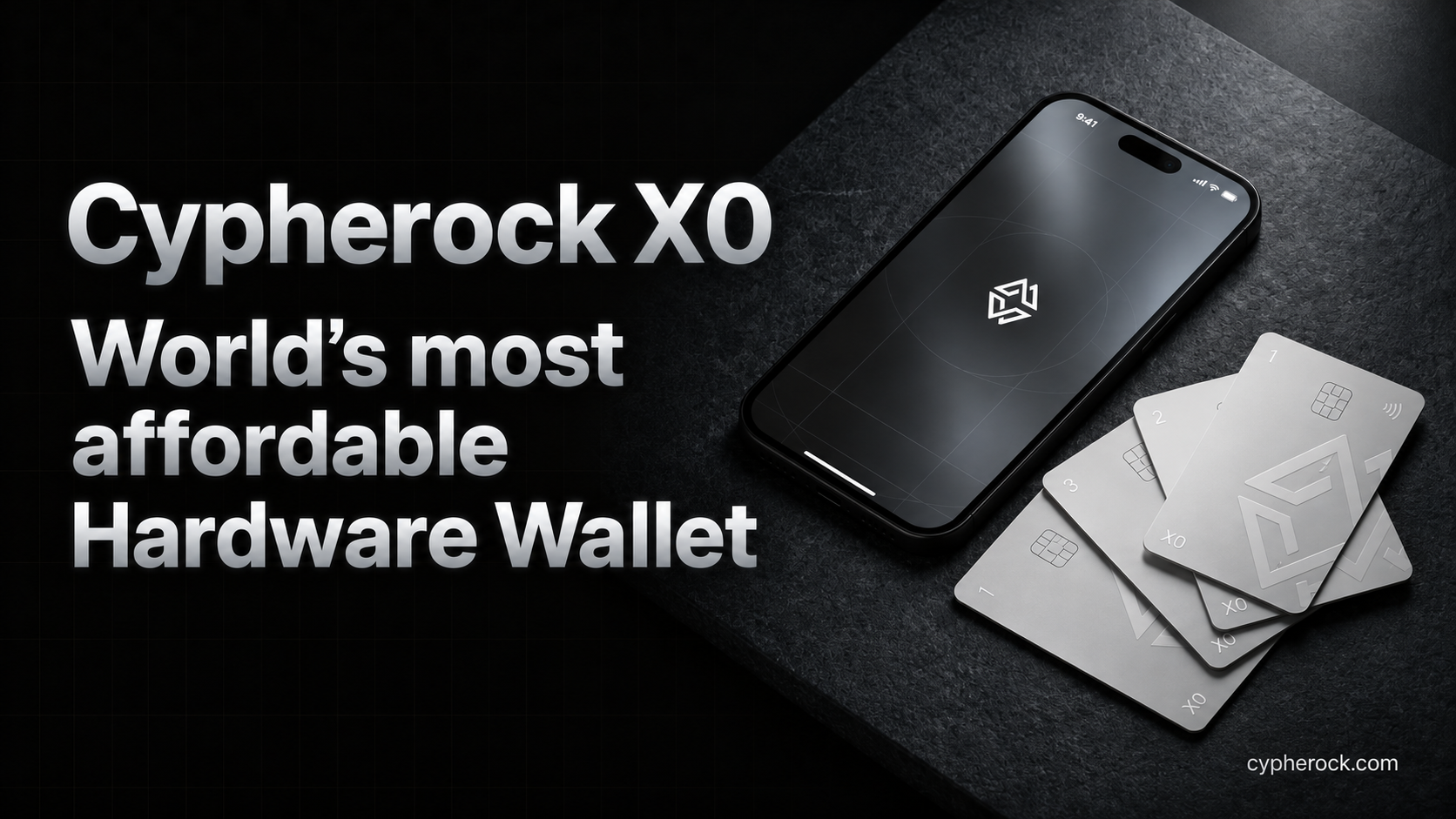
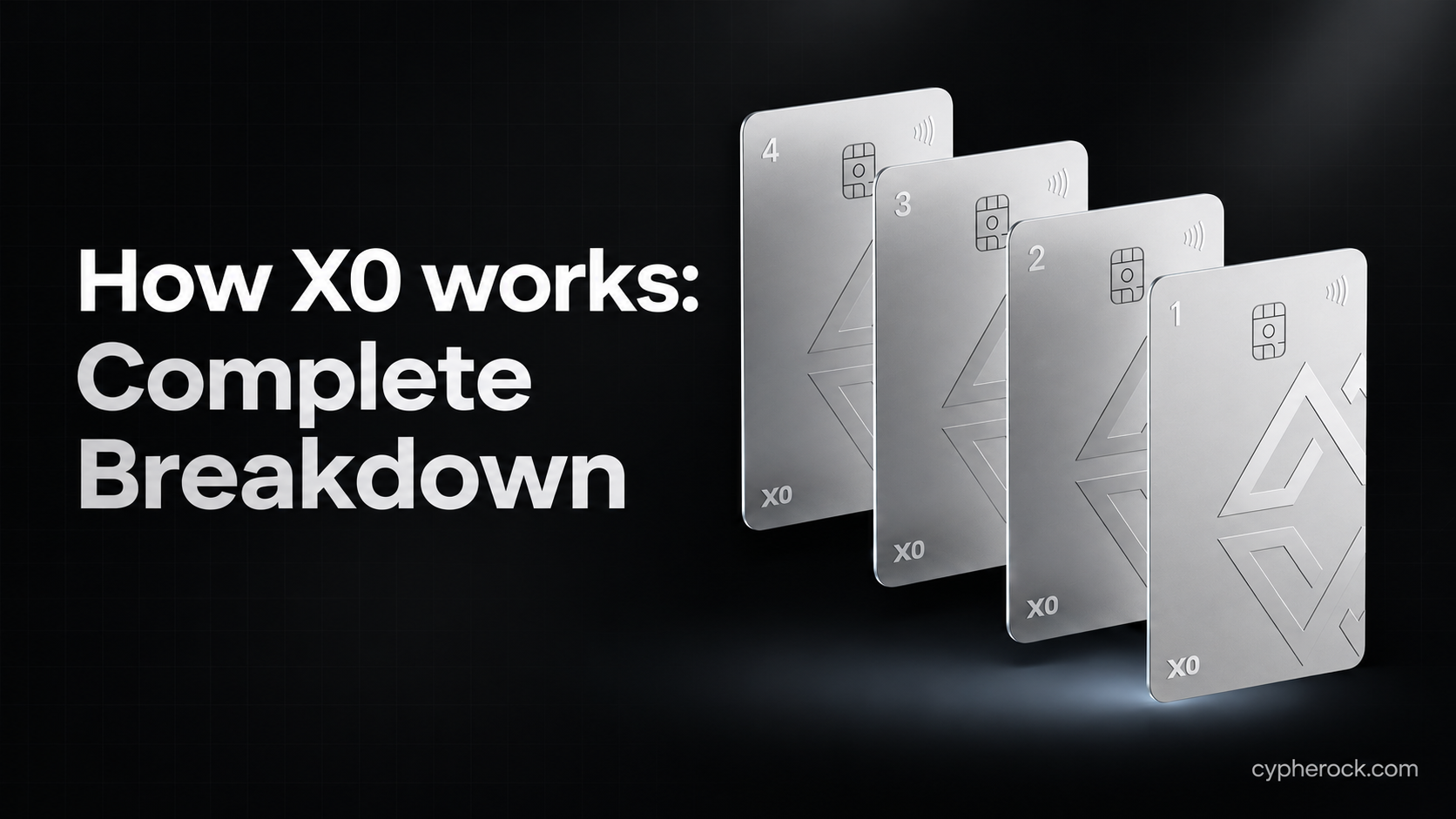
Cypherock X1 vs Cypherock X0: Which Hardware Wallet Is Right for You?
When Cypherock launched the X1 in 2022, it challenged one of the biggest assumptions in crypto security: that protecting your assets requires writing down a seed phrase.
Instead, X1 introduced a distributed security architecture built around Shamir Secret Sharing, eliminating the single point of failure created by traditional seed phrase backups. The product was independently audited by Keylabs and Wallet Scrutiny, whose audits praised its innovative security design, and X1 has since become Cypherock's flagship hardware wallet.
Now comes Cypherock X0.
Rather than replacing X1, X0 extends the same security philosophy to a completely different audience.
So which wallet should you choose?
The answer depends less on security, and more on how you want to use your crypto.
Quick Comparison
Feature | Cypherock X1 | Cypherock X0 |
|---|---|---|
Target User | Long-term investors & power users | Everyday mobile-first users |
Components | X1 Vault + 4 NFC Cards | Smartphone + 4 NFC Cards |
Display | OLED display on Vault | Smartphone display |
Transaction Approval | Vault + Card | Smartphone + Card |
Primary Platform | Desktop (mobile companion) | Mobile-first |
Secure Computation | Vault Secure Element | Card Secure Element |
Wallet Recovery | Any 2 of 5 components | Any 2 cards |
Shamir Secret Sharing | ✅ | ✅ |
Eliminates seed phrase vulnerability | ✅ | ✅ |
Keylabs and Wallet Scrutiny-validated security philosophy | ✅ | Built upon X1 architecture |
One Security Philosophy. Two Different Experiences.
Although X1 and X0 look different, they share the same core philosophy.
Both wallets are built around three principles:
Eliminate single points of failure.
Never permanently store the complete wallet in one place.
Perform sensitive cryptographic operations inside certified secure hardware.
In both wallets:
Wallets are split using Shamir Secret Sharing
No single point of failure
Private keys are reconstructed only temporarily
Sensitive data is erased immediately after signing
The difference lies in where those cryptographic operations happen.
X1: The Vault-Centric Architecture
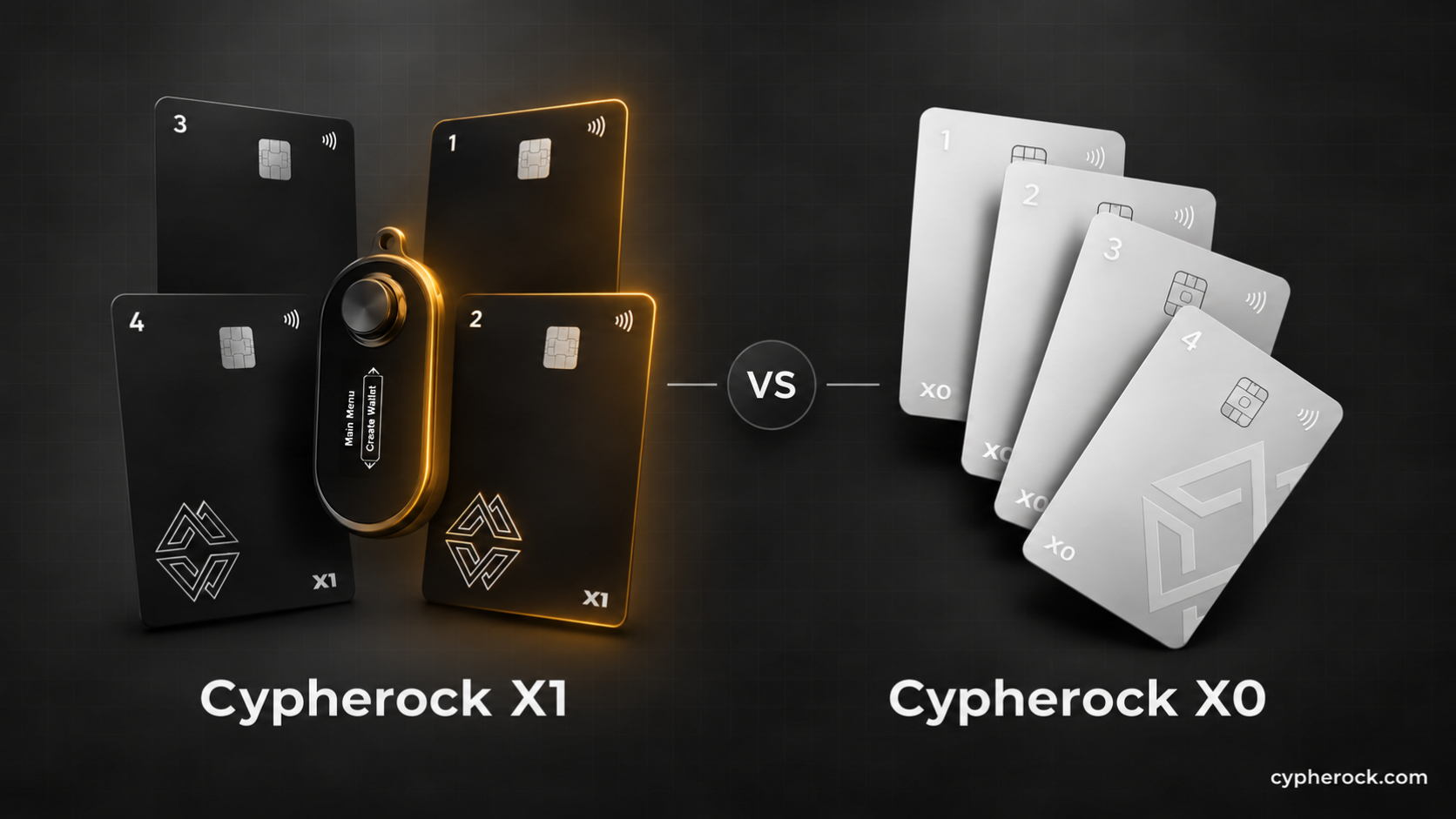
Cypherock X1 consists of:
One X1 Vault
Four NFC Cards
The Vault is the primary device.
It contains:
OLED display
Physical joystick
Secure Element
Transaction verification interface
When signing a transaction:
The Vault communicates with one of the NFC cards.
The Vault reconstructs the wallet.
The Vault derives the private key.
The Vault signs the transaction.
The temporary key material is erased.
The Vault acts as the trusted computing environment.
X0: The Card-Centric Architecture
Cypherock X0 removes the dedicated Vault entirely.
Instead, it consists of:
Four NFC Cards
X0 Mobile app
Your smartphone
The smartphone replaces only the interface, not the security hardware.
When signing:
The phone prepares the unsigned transaction.
The phone securely sends its encrypted shard.
The card reconstructs the wallet.
The card derives the private key.
The card signs the transaction.
The card erases all temporary secrets.
The phone never becomes the trusted device.
Where Does Signing Happen?
This is the biggest technical difference.
Cypherock X1
Everything security-sensitive happens inside the Vault.
The Vault is responsible for:
Wallet reconstruction
Key derivation
Transaction signing
The NFC card simply contributes its cryptographic shard.
Cypherock X0
Everything happens inside the card.
The card performs:
Wallet reconstruction
Key derivation
Transaction signing
Secure memory wiping
The smartphone provides the user interface and securely relays its encrypted shard. The phone sends the encrypted shard and the unsigned transaction hash.
Desktop vs Mobile
This is where user experience changes the most.
Cypherock X1
Designed primarily for users who:
Store larger portfolios
Prefer desktop management
Want an offline transaction verification device
Appreciate a dedicated hardware interface
The OLED screen and joystick allow users to independently review transaction details before approving them.
Cypherock X0
Designed for users who:
Live on their smartphones
Want the fastest onboarding
Need maximum portability
Prefer tap-and-go interactions
Everything happens directly from the mobile app.
No separate display.
No desktop dependency.
Hardware Components
Cypherock X1
You carry:
X1 Vault
Any one NFC card
For transactions.
Cypherock X0
You carry:
Your phone
Any one NFC card
That's all.
Removing the Vault significantly simplifies everyday carry.
Wallet Recovery
Both wallets use the same 2-of-5 Shamir Secret Sharing philosophy.
X1
Recovery requires any two valid components from:
Vault
Four cards
The distributed backup model removes reliance on a written seed phrase.
X0
Recovery works slightly differently.
If your phone is lost:
Install cySync on a new phone.
Tap any two cards.
The wallet is reconstructed inside the Secure Element.
A new phone shard is created.
All cards receive refreshed shards.
Recovery never requires exposing a seed phrase.
The Role of the Smartphone
Cypherock X1
The phone is optional.
Most operations revolve around the Vault and desktop application.
Cypherock X0
The phone becomes the primary interface.
But importantly, it is not the trusted device.
It:
Stores one encrypted shard
Builds transactions
Relays encrypted messages
Broadcasts signed transaction hash
It never:
Reconstructs wallets
Derives private keys
Signs transactions
This separation preserves the same security philosophy introduced with X1.
Which Wallet Is Faster?
For daily transactions, X0 is generally more convenient.
Simply:
Open the app.
Create a transaction.
Tap any card.
Done.
X1 adds one additional hardware component, the Vault, which provides stronger independent transaction verification but introduces an extra device into the workflow.
Neither approach is objectively better.
They simply optimize for different priorities.
Which Wallet Is More Portable?
X0 wins here.
Since almost everyone already carries a smartphone, daily use requires only:
Phone
One NFC card
X1 requires carrying:
Vault
One NFC card
Desktop
Users who travel frequently or primarily interact with crypto through their phones may prefer X0's lighter setup.
Which Wallet Is Better for Long-Term Storage?
This depends on your preferences.
Choose X1 if you want:
A dedicated signing device
Independent OLED transaction verification
Desktop-first workflow
Maximum hardware separation
Choose X0 if you want:
Mobile-first experience
Fewer devices
Faster transactions
Lower entry cost
The same distributed security philosophy in a more portable form.
Security: Different Architectures, Same Goal
One common misconception is that X0 is simply a "lighter" version of X1.
It isn't.
Instead, it moves the trusted computing environment from the Vault to the card.
In X1:
Vault → Secure computation
In X0:
Card → Secure computation
The philosophy remains identical:
No permanent complete wallet storage
Distributed key protection
Temporary reconstruction only
Secure memory wiping after signing
Sensitive operations confined to certified secure hardware
The hardware changes.
The security principles do not.
Which One Should You Buy?
Choose Cypherock X1 if you:
Manage significant crypto holdings
Prefer a dedicated hardware interface
Want offline transaction verification on a separate display
Like a desktop-first workflow
Value additional hardware separation for long-term storage
Choose Cypherock X0 if you:
Primarily use your smartphone for crypto
Want the simplest everyday experience
Prefer carrying fewer devices
Want an affordable entry into hardware-backed self-custody
Need fast, mobile-first transactions without sacrificing the distributed security model
Two Wallets, One Vision
Cypherock X1 and X0 are not competitors; they are complementary products built on the same foundation.
X1 introduced a new way of thinking about self-custody by eliminating reliance on a single seed phrase and distributing trust across multiple hardware components. Its Keylabs and Wallet Scrutiny-audited architecture demonstrated that strong security could be achieved without traditional recovery methods.
X0 carries that philosophy into a mobile-first world. By moving secure computation from the Vault to the NFC card while keeping the smartphone limited to interface and encrypted shard storage, it delivers the same core principles in a simpler, more portable form factor.
The key difference between Cypherock X0 and X1 is their supported blockchain coverage: while both support a broad multi-chain ecosystem, X0 Founder's Edition currently supports 15 networks with approximately 22,900+ coins and tokens, including Bitcoin, Litecoin, Dogecoin, Dash, Ethereum, Polygon, BNB Smart Chain, Fantom, Avalanche, Optimism, Arbitrum, Hyperliquid, Base, Tron, and XRP; X1 supports additional networks that are currently excluded from X0 Founder's Edition, including Solana, NEAR, Starknet, Internet Computer (ICP), Stellar, Sia, and Canton. This difference is because the X0 Card currently derives secp256k1 keys, whereas the excluded networks use Ed25519 or other cryptographic curves. More networks and tokens are planned to be added to the standard X0 version in the near future.
Whether you choose X1 or X0, you're choosing a hardware wallet designed around the same idea: eliminate single points of failure, keep sensitive cryptographic operations inside secure hardware, and make self-custody easier without compromising security.