0
$0.00
0 items

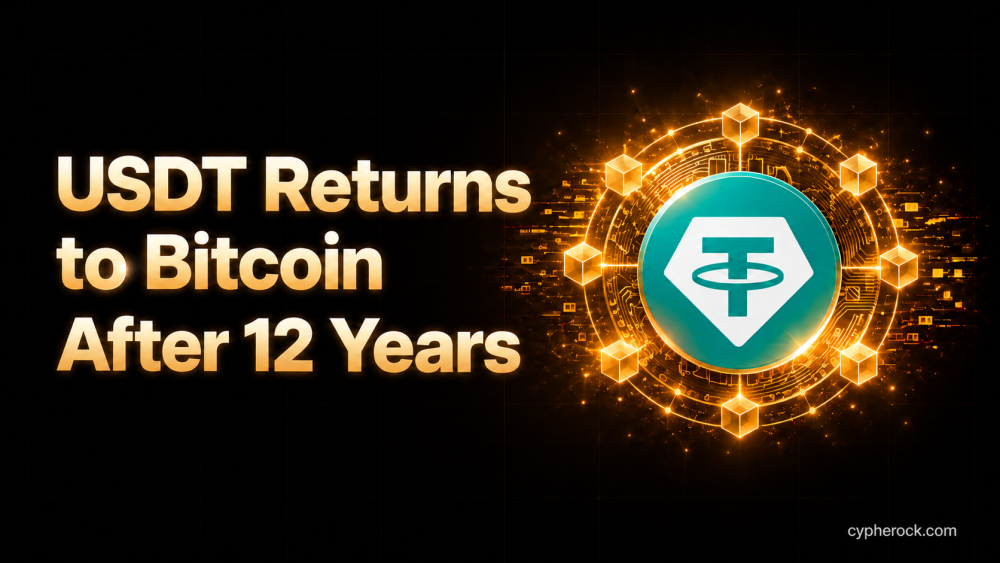
Tether CEO Paolo Ardoino publicly backed the initiative, coining the phrase "It's coming home." The world's largest stablecoin is returning to the world's largest blockchain. Tether is reintroducing USDT to Bitcoin in October 2026, 12 years after abandoning it for faster, cheaper networks like Tron and Ethereum. Utexo, a project actively backed by Tether, officially announced the launch of USDT on Bitcoin under a new commercial license. The technology stack combines the security of Bitcoin's base layer, the speed of the Lightning Network, and the privacy of the RGB protocol.
Bitcoin is trading at $86,688 today, up 3.38% on soft US jobs data that reduced rate hike expectations. The market is watching $90,000. And quietly, something structurally more significant than a price milestone is happening: the most-used stablecoin in the world is being natively issued on the most secure blockchain in the world, using a protocol architecture that changes how self-custody of dollar-denominated assets works at a fundamental level.
This blog explains exactly what USDT on Bitcoin is, how the RGB protocol works, what it means for hardware wallet holders, and what the self-custody picture looks like once dollar settlements and Bitcoin security coexist at the same address.
Tether originally launched USDT on Bitcoin in 2014 using the Omni protocol, which recorded tokens on the Bitcoin blockchain. Omni was functional but slow, expensive, and dependent on Bitcoin transaction fees that made small USDT transfers economically impractical. Tether migrated to Ethereum in 2017 and Tron in 2019. Bitcoin-based USDT became a footnote.
Utexo's version of USDT on Bitcoin is built differently from its counterparts on Ethereum and Tron, relying on Bitcoin's own UTXO structure instead of the account-based models those networks use. This architecture lets Utexo support private USDT transfers, native swaps between BTC and USDT, and BTC-backed lending that does not require wrapping bitcoin into a synthetic token.
The RGB protocol is the technical foundation that makes this possible. Client-side validation keeps most transaction data off the public ledger, enabling private B2B transfers, direct BTC-USDT swaps, and BTC-backed lending without wrapped tokens.
In practical terms: USDT on Bitcoin via RGB is not a layer-2 token or a wrapped asset. It is a native Bitcoin UTXO with additional state embedded through client-side validation. The Bitcoin network secures the ownership. The RGB layer carries the stablecoin denomination. Both live at a Bitcoin address.
USDT on Ethereum is transparent by default. Every transfer, every balance, every approval is publicly visible on the Ethereum blockchain. This is both a transparency feature and a privacy liability — anyone who knows your Ethereum address can see your complete USDT transaction history.
Within the proposed system, Utexo intends to maintain a list of transaction outputs associated with sanctioned or illegal activity and share it with exchanges and other regulated parties, a compliance mechanism that works without exposing all transaction data publicly.
Because RGB assets are tied to Bitcoin transaction outputs, Utexo cannot freeze them through the same mechanism Tether uses for its Ethereum token. This is a significant custody distinction. On Ethereum, Tether has the ability to blacklist specific addresses and freeze USDT balances, a centralised control mechanism that has been exercised in law enforcement contexts. On Bitcoin via RGB, that same freeze mechanism does not apply to individual UTXOs in the same way.
For self-custody holders, this distinction matters: users will be able to conduct confidential USDT transfers, swap BTC for USDT without exchanges, and secure loans using bitcoin collateral.
Here is the angle that every other coverage piece is missing: USDT on Bitcoin means that a Bitcoin hardware wallet, including Cypherock X1's native Bitcoin account, will be capable of holding dollar-denominated stablecoins at the same address as your Bitcoin, secured by the same private key architecture.
This is not a trivial development for self-custody holders. Today, holding Bitcoin in cold storage and holding USDT in cold storage requires either two separate wallet ecosystems (a Bitcoin hardware wallet and an Ethereum hardware wallet), or a multi-chain hardware wallet that manages both. The former creates operational complexity; the latter requires an EVM account for USDT alongside a UTXO account for Bitcoin.
USDT on Bitcoin, once broadly supported by wallet software, means your Bitcoin cold storage address becomes your dollar cold storage address simultaneously. One private key. One hardware wallet. Bitcoin and USDT in the same UTXO-native environment.
Hundreds of exchanges and wallets have already expressed interest in the launch. Wallet software support for RGB-based USDT is the integration work that determines how quickly this becomes a practical reality for hardware wallet users. Cypherock's cySync and the broader hardware wallet ecosystem will need to implement RGB asset display and transaction signing before this becomes seamless, watch for updates at cypherock.com/coin-support.
Utexo plans to integrate USDT into the Lightning Network, Bitcoin's faster payment layer, as a later stage. This is where the payments use case becomes genuinely compelling.
Lightning Network enables near-instant, near-zero-fee Bitcoin payments by routing transactions through off-chain payment channels. Adding USDT to Lightning means dollar-denominated payments at the speed and cost profile of Lightning, without the settlement finality delays of Ethereum or Tron.
Utexo's RGB release in October 2026 is intended to turn Bitcoin from a store-of-value asset into a settlement rail for dollar transactions. For self-custody holders, this means the same hardware wallet that holds your long-term Bitcoin savings could eventually sign Lightning USDT payments for everyday purchases, a significant convergence of cold storage security and payment utility.
For holders weighing where to hold USDT in self-custody, the comparison between Bitcoin-native RGB USDT and Ethereum ERC-20 USDT comes down to four dimensions:
| USDT on Ethereum (ERC-20) | USDT on Bitcoin (RGB) | |
|---|---|---|
| Blockchain security | Ethereum (PoS, $300B+ staked) | Bitcoin (PoW, $1.7T+ market cap) |
| Transaction privacy | Fully public ledger | Client-side validation, mostly private |
| Tether freeze risk | Address blacklisting possible | UTXO-level freeze not directly applicable |
| Hardware wallet support | Widely supported (Ledger, Cypherock X1) | Emerging, watch for wallet software updates |
| DeFi compatibility | Deep EVM DeFi ecosystem | Limited, early stage |
Neither is objectively superior for every use case. Ethereum USDT has deep DeFi integration and wide hardware wallet support today. Bitcoin USDT offers superior base-layer security and privacy properties, but wallet support is launching now and DeFi integrations will take time to develop.
For long-term cold storage of significant USDT holdings where privacy and Bitcoin-grade security matter more than immediate DeFi access, Bitcoin-native USDT is the more compelling architecture once wallet support matures.
A USDT balance on Bitcoin represents a dollar claim on Tether, meaning it offers no exposure to Bitcoin's price fluctuations, and the limits and rules governing Bitcoin's 21 million coins remain unchanged.
This is the important caveat. USDT on Bitcoin is still USDT, a dollar claim on Tether's reserves. The Bitcoin network secures the ownership and transfer of that claim. Tether's reserves back the dollar peg. Both layers of the system have their own risk profiles.
What Bitcoin-native USDT does change is the custody layer: the security of your private key and the architecture of your hardware wallet now directly determine the security of your dollar holdings, in the same way they determine the security of your Bitcoin. No exchange account. No EVM approval risk. No platform withdrawal freeze.
This is the same principle that has always governed Bitcoin self-custody, applied for the first time to a dollar-denominated asset on Bitcoin's native infrastructure.

Tether-backed Utexo is launching USDT on Bitcoin using RGB and Lightning after a $7.5 million seed round co-led by Tether. The October 2026 launch is the beginning of something that, if wallet ecosystem support follows, could fundamentally change how self-custody holders think about holding both Bitcoin and dollar-denominated assets.
Today, holding USDT in genuine cold storage requires a multi-chain hardware wallet and an Ethereum or Tron account. Tomorrow, once RGB USDT wallet support arrives, it may require only a Bitcoin hardware wallet and the same private key architecture that secures your Bitcoin.
Bitcoin at $86,688 is recovering toward $90,000. But the more significant development today is not the price. It is USDT coming home to Bitcoin, and what that means for every hardware wallet holder who wants to secure both their Bitcoin savings and their dollar holdings in the same, maximally secure, self-custodied environment.
Check the Cypherock coin support page for the latest on Bitcoin and USDT support across networks. Explore Cypherock X1 for multi-chain self-custody today.
Related Reading:-