0
$0.00
0 items

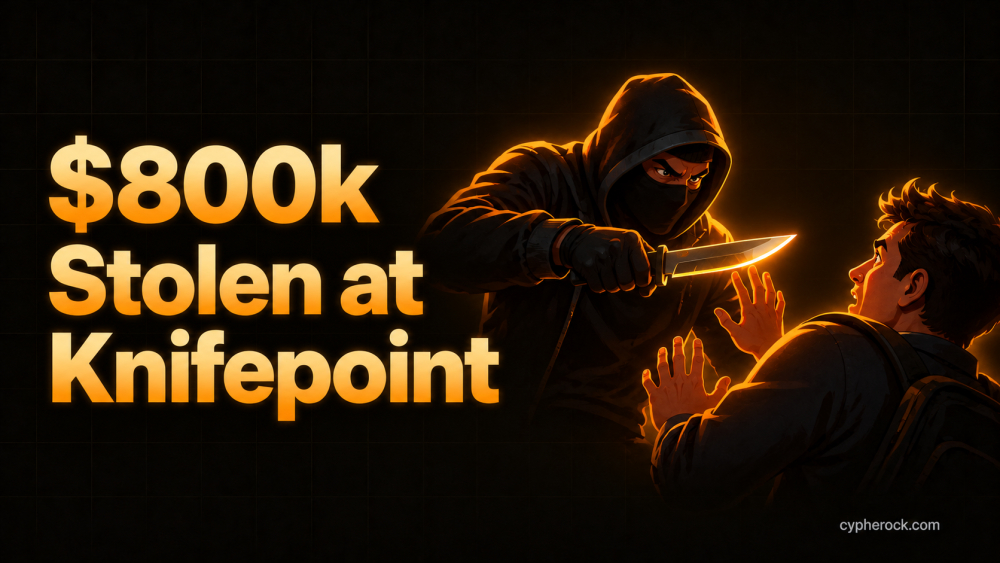
This morning, a UK crypto trader known as @rrealist posted on X from what he described as an active crime scene.
Masked intruders attacked a Solihull trader with hammers and forced him to transfer his crypto. Under that pressure, James transferred crypto worth hundreds of thousands of pounds into wallets held by the attackers.
On-chain data confirms the identified wallet received nearly 719,000 USDC, which was subsequently moved to another address. Of the roughly $800,000 stolen, $40,000 came from the main wallet and $720,000 from a Ledger hardware wallet. A Rolex watch was also taken, and his phone was smashed on the spot. The poster said they suffered no serious injuries, only minor bruising.
No arrests have been made.
This is the physical attack scenario that every hardware wallet guide footnotes and then moves on from. Today it happened to a real person, in a suburb of Birmingham, in broad daylight. And because it is happening with increasing frequency, recent data shows that around $30 million has been lost to violent robberies through mid-2026, it deserves more than a footnote.
This blog explains exactly how physical crypto attacks work, why they succeeded against a hardware wallet holder in today’s case, and what architectural changes, not just behavioural changes, can reduce your exposure.
Three knife-wielding intruders allegedly restrained the victim and forced him to surrender funds from his crypto wallets. The victim claimed the intruders stole $40,000 from his main wallets and another $720,000 from a Ledger hardware wallet.
A fourth person reportedly directed them in real time over a video call, essentially running the robbery remotely.
The attack is technically known as a “wrench attack,” named for the principle that physical coercion bypasses all cryptographic security. The Ledger hardware wallet protected against remote hackers, clipboard malware, and phishing attacks perfectly. It could not protect against a knife held to its owner’s face.
This is not a failure of the hardware wallet. It is a failure of the threat model. Standard hardware wallet security advice assumes your attacker is remote: a hacker, a phisher, a malware developer. It provides no direct protection against an attacker who is physically present and threatening your life.
The victim had done almost everything right. He used a hardware wallet. He kept significant holdings off exchanges. He had a working self-custody setup. And he still lost $800,000 in minutes.
Today’s attack is not isolated. It is part of a documented, accelerating pattern.
Chainalysis found that family members and acquaintances of cryptocurrency holders were targeted in approximately 25–30% of documented physical attacks during the first half of 2026. This means attackers are not randomly targeting people who look wealthy. They are using social networks, researching public profiles, identifying crypto holders through online activity, mapping relationships, and targeting not just the holder but their family members.
A Solihull crypto trader was beaten with hammers and forced to transfer his crypto. On September 24, 2026, Crimestoppers announced a £10,000 reward for information leading to the people responsible. The September incident and today’s October attack both occurred in the West Midlands, suggesting targeted local activity, not random opportunism.
The profile of the physical attack victim in 2026 is specific: publicly identifiable as a crypto holder, with significant holdings in a single-device hardware wallet setup, and a home address that is either public or discoverable through social network research.
Every element of that profile is something you can change.
Here is the architectural reality that today’s attack reveals most clearly: a hardware wallet that holds complete access in a single device is also a hardware wallet that can be coerced with a single act of violence.
The Ledger device in today’s attack held enough authorisation to transfer $720,000 with a single PIN entry. The PIN was obtained through physical coercion. The transaction was completed. The blockchain settled it irreversibly.
The single-device hardware wallet model concentrates two things simultaneously: the security of your crypto and the coercive value to an attacker. The device is the key. Whoever controls the device, whether legitimately or through coercion, controls the funds.
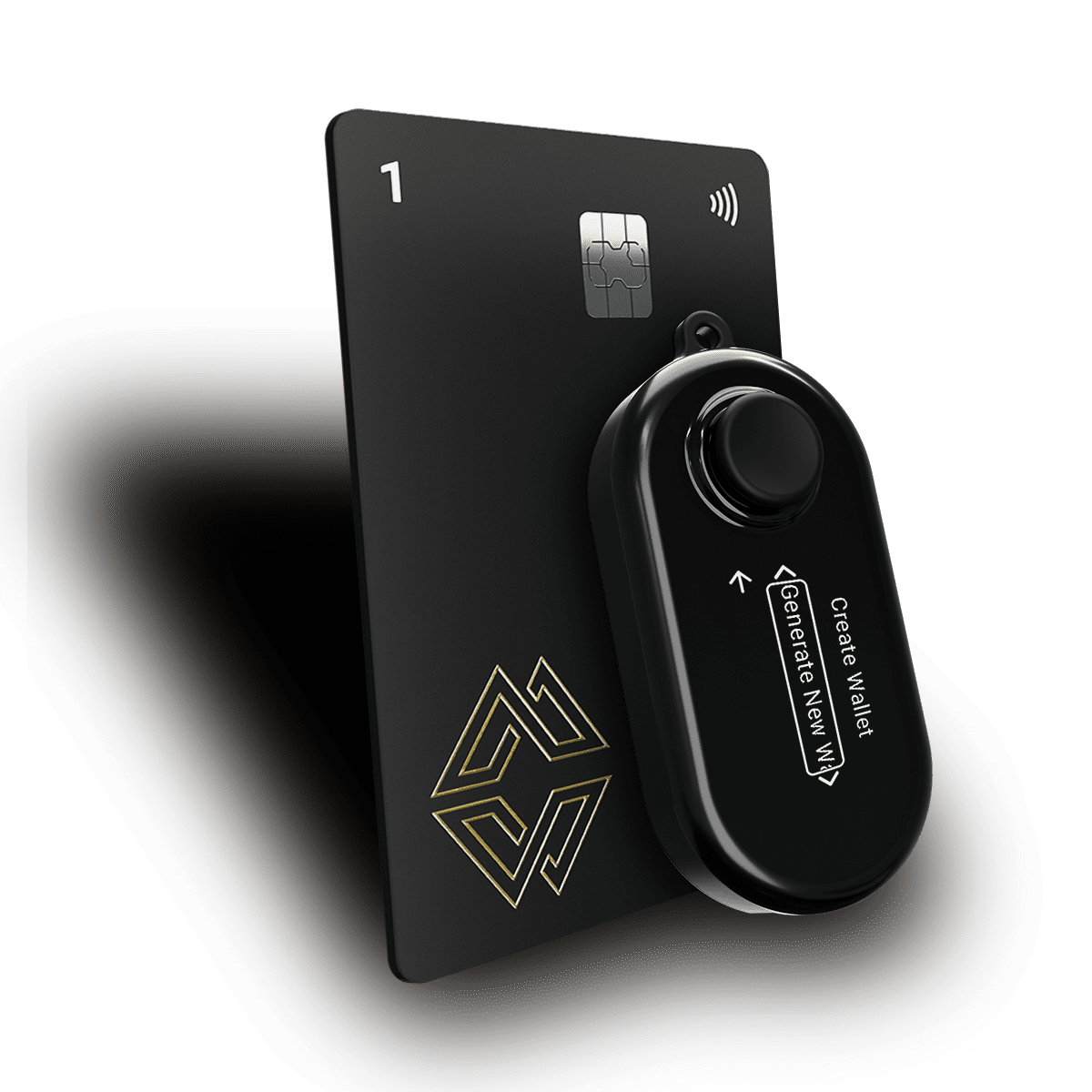
Cypherock X1 distributes your key material across five hardware components using Shamir’s Secret Sharing, 1 X1 Vault and 4 X1 Cards, any 2 of 5 required to sign a transaction. The X1 has been independently audited by both Keylabs and Wallet Scrutiny, validating the integrity of this architecture. This design changes the physical attack calculus in a specific and meaningful way.
An attacker who obtains your X1 Vault under coercion has 1 of 5 key shares, mathematically insufficient to sign any transaction. They have gained nothing of cryptographic value. To drain your wallet under coercion, they must simultaneously possess both the Vault and at least one Card from a separate location, and know the PIN for each.
If your Cards are genuinely distributed across geographically separate locations, a home safe, a bank safety deposit box, a family member in another city, a physical attacker at your home has access to at most the Vault and one Card. Even with both in hand and both PINs extracted under duress, they have exactly 2 of 5 shares: the minimum threshold. But if your distribution strategy means no Card is kept at your primary residence alongside the Vault, the attacker at your home has 1 of 5 shares. Nothing.
This is not invulnerability. It is structural resistance: the attacker must coordinate access to multiple physically separated locations, each with independent PINs, to extract any value. The operational complexity of a physical crypto robbery multiplies proportionally with the distribution of key material.
Beyond hardware architecture, today’s attack reveals several operational security failures that any holder can correct.
The victim was known online as a crypto trader. His handle was publicly associated with crypto wealth. Attackers who research targets, and documented cases show they absolutely do, use public social media, crypto Twitter activity, conference appearances, and even on-chain address publicisation to identify high-value targets and their locations.
Physical attacks targeting crypto holders rise in 2026. The correlation with increased public crypto discourse is direct. Reduce your public footprint. Do not announce holdings, profits, or specific wallet addresses in public forums. Do not associate your legal name, home address, or daily schedule with crypto wealth in any public context.
The victim’s Ledger, with its PIN, was accessible at his home. A distributed hardware wallet setup, where no single location contains sufficient key material for a complete transaction, removes the possibility of a single-location robbery yielding complete access.
Some hardware wallets, including certain Trezor and Coldcard configurations, support passphrase-based secondary wallets. A "duress" wallet opens under coercion to reveal a small legitimate balance while the primary holdings remain protected by a different passphrase. This does not prevent the robbery but limits the damage by providing the attacker with a plausible but limited balance. Verify whether your hardware wallet supports this feature.
For Cypherock X1 users: confirm today that no two required components for a transaction threshold are accessible from your primary residence simultaneously. The Vault can be at home for daily transaction use. The Cards should be distributed: home safe, office, safety deposit box, trusted family member in another location. A home invasion that produces the Vault and one Card should still produce insufficient key material for a complete transaction if your distribution strategy is robust.
Today's attack raises a dimension beyond the immediate robbery: what happens to the remaining crypto if the victim had been killed rather than just injured?
A crypto transaction sent under duress usually cannot be reversed. But a holder who dies in a physical attack, with their hardware wallet components distributed in locations unknown to their family, has essentially created an inheritance failure as well as a security failure.
The combination of physical attack risk and inheritance planning converges at a single point: someone other than you may need to access your crypto in circumstances you did not choose. Whether that person is a beneficiary after your death or an attacker during your life, the architecture of your key management determines the outcome.
Cypherock Cover addresses the legitimate side of this: structured, non-custodial inheritance planning that gives beneficiaries a documented pathway to access your holdings without seed phrase disclosure during your lifetime. It does not defeat a knife. It ensures that if a robbery or attack results in the worst outcome, your family is not also left without access to their inheritance.
No. Physical coercion, specifically threatening violence to obtain a PIN or passphrase, bypasses all cryptographic security. The question is not "which wallet defeats coercion" but "which architecture raises the cost and complexity of a successful coercive attack." Distributed key architectures like Cypherock X1 raise that cost significantly by requiring access to multiple physically separated components.
A passphrase adds a layer of protection. An attacker who obtains your seed phrase but not your passphrase cannot access your primary holdings. But under physical coercion, both the seed phrase and the passphrase are at risk of disclosure. The passphrase is more useful against remote attackers and device theft than against in-person coercion.
The principle is correct but the framing is imprecise. The goal is to ensure that no single physical location contains sufficient key material to complete a transaction against your primary holdings. This is different from "keeping less at home." It is about distributing the authorisation threshold, not reducing total holdings.
Your life is worth more than any amount of crypto. Comply. The blockchain is irreversible, but human life is not. After safety is secured, contact police immediately, notify relevant exchanges to flag the receiving addresses (some frozen USDC cases have resulted in partial asset recovery), and document everything for law enforcement and insurance purposes.
James transferred crypto worth hundreds of thousands of pounds into wallets held by the attackers. As of early October 2026, nobody has been arrested.
The blockchain confirmed the transactions in seconds. There is no reversal mechanism, no customer support line, and no insurance claim that restores what was transferred under coercion.
Physical crypto attacks are not a novelty. They are a documented, growing threat category that specifically targets identified holders with single-device hardware wallet setups in known locations. Around $30 million has been lost to violent robberies through mid-2026. The number will be higher by year end.
The hardware wallet solved the remote attack problem. The distributed key architecture is the next step: building physical attack resistance into the hardware itself by ensuring that no single location, however compromised, yields complete access to your holdings.
Distribute your keys. Reduce your public footprint. Know your Card locations. And if the worst happens: comply, survive, and report.
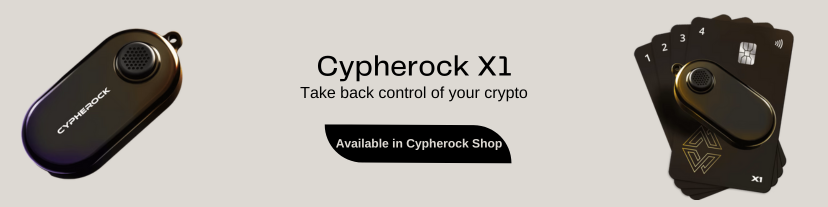
Review your key distribution strategy today: explore Cypherock X1's distributed architecture and ensure your X1 Cards are in genuinely separate locations. Set up Cypherock Cover for inheritance planning, so your family's access does not depend on your attacker's mercy.
Related Reading:-