0
$0.00
0 items

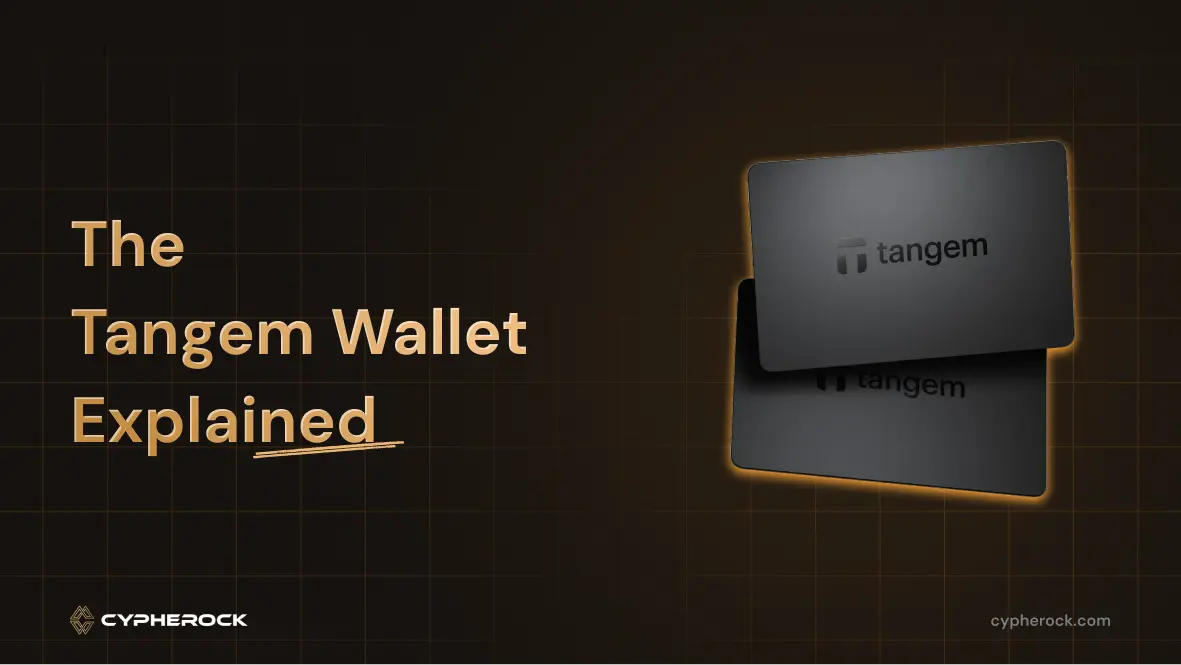
If you've been looking into hardware wallets, Tangem has probably come up early. It's card-sized, works via NFC tap, requires no seed phrase, and takes about three minutes to set up. For a category that has historically been intimidating to newcomers, that combination is genuinely compelling and it explains why Tangem has sold over two million devices since launching in 2018.
This guide is a complete, up-to-date look at how Tangem works in 2026: its current product lineup, new features like Tangem Pay and Yield Mode, what it does well, and where its security model has real limits. If you're deciding whether Tangem is the right wallet for your situation, this is the place to start.
Every cryptocurrency you hold is controlled by a private key. Whoever holds that key owns the asset- no bank, no platform, no recourse. If a private key stored on an exchange or hot wallet is compromised, the funds are gone permanently.
The risk is not theoretical. Hackers stole approximately $1.38 billion in crypto in the first half of 2024 alone, nearly double the same period in 2023. The $1.5B Bybit hack in February 2025 and the $270M Drift Protocol exploit in April 2026 both involved compromised approval flows, not brute-force attacks. Sophisticated threats increasingly target the layer between your wallet and the apps you interact with, not the wallet itself.
A hardware wallet keeps your private key offline, inside a dedicated secure chip, isolated from internet-connected systems. It signs transactions internally and only releases the signed output, never the key itself. That offline isolation is the foundational security primitive that no hot wallet or exchange can replicate.
For deeper context on self-custody best practices, see our guide to self-custodying CC tokens.
Tangem launched in 2018 with a clear thesis: cold storage should be as simple as a tap-to-pay card. Over two million devices have been sold since, with no reported hardware hack to date.
Rather than a USB device or touchscreen unit, Tangem gives you a set of NFC-enabled smart cards, the same dimensions as a credit card and an optional Tangem Ring, a ceramic wearable that carries the same secure chip. Setup requires no seed phrase, no computer, and no cables.
The secure element is a Samsung chip, EAL6+ certified which is one of the highest security certifications available for hardware components. The firmware is immutable; it cannot be updated after manufacture, which eliminates a class of supply-chain attacks but also means no future feature additions at the hardware level.
Each Tangem card generates its private key inside the secure chip at the moment of initialization. The key never leaves the chip as it cannot be read, exported, or copied. Transactions are signed internally, and only the signed output is released to the app.
The card communicates with your smartphone via NFC - the same protocol used for contactless payments. No cables, no batteries, no ports. You tap the card to the phone to confirm a transaction.
The Tangem app (iOS and Android) is your interface for managing assets. It does not store your private key. It constructs unsigned transactions, passes them to the card via NFC for signing, and broadcasts the signed transaction to the blockchain. App version 5.34, released in March 2026, added universal token swapping across supported chains and multi-account support.
Tangem now supports 16,000+ tokens- up significantly from roughly 6,000 tokens in earlier versions. Bitcoin, Ethereum, and most major L1s and L2s are covered.
Tangem Pay lets users spend USDC directly from cold storage via a virtual Visa card, settled on Polygon. It integrates with Apple Pay and Google Pay, making it possible to pay at any contactless terminal without first moving funds to a hot wallet. Tangem Pay launched in April 2026 and is currently available in the U.S., Latin America, and Asia-Pacific, with a physical Visa card planned for later in 2026.
This is a genuine convenience innovation. Spending from cold storage without a custody handoff addresses a real friction point — though see the security section below for important context on the phone-dependency this model creates.
Tangem Yield Mode allows users to earn passive income via an Aave integration, with assets remaining liquid. This positions Tangem in territory most cold wallets avoid: active financial utility rather than pure storage. It's a useful feature for users comfortable with DeFi-adjacent risk, but it also means more active interaction between the wallet and live protocols.
EAL6+ certified Samsung secure element. Purpose-built to resist both physical and remote attacks. Independent audits by Kudelski Security have confirmed no backdoors.
No seed phrase. There's no 24-word phrase to write down, misplace, photograph, or have stolen. Recovery is handled through backup cards.
Immutable firmware. The hardware configuration cannot be modified post-manufacture, removing a post-sale attack surface.
Durability. Tangem devices are IP69K rated - water, dust, and temperature resistant (–25°C to +50°C), with a 25-year minimum chip lifetime.
Privacy. No account creation required. Tangem doesn't run servers that process your transactions.
This is Tangem's most consequential limitation. The card has no display. Transaction details such as recipient address, token amount, contract interactions are shown only on your phone. You are trusting your phone's screen to accurately represent what the card is being asked to sign.
This is exactly the attack surface at the center of blind-signing exploits. A compromised app, a malicious dApp approval, or a phishing site can present a fraudulent transaction on your phone screen, and the card has no independent way to flag it. The card signs whatever it receives. The $1.5B Bybit hack and the $270M Drift Protocol exploit both involved manipulated approval flows, precisely the scenario where on-device verification would have been the last line of defense.
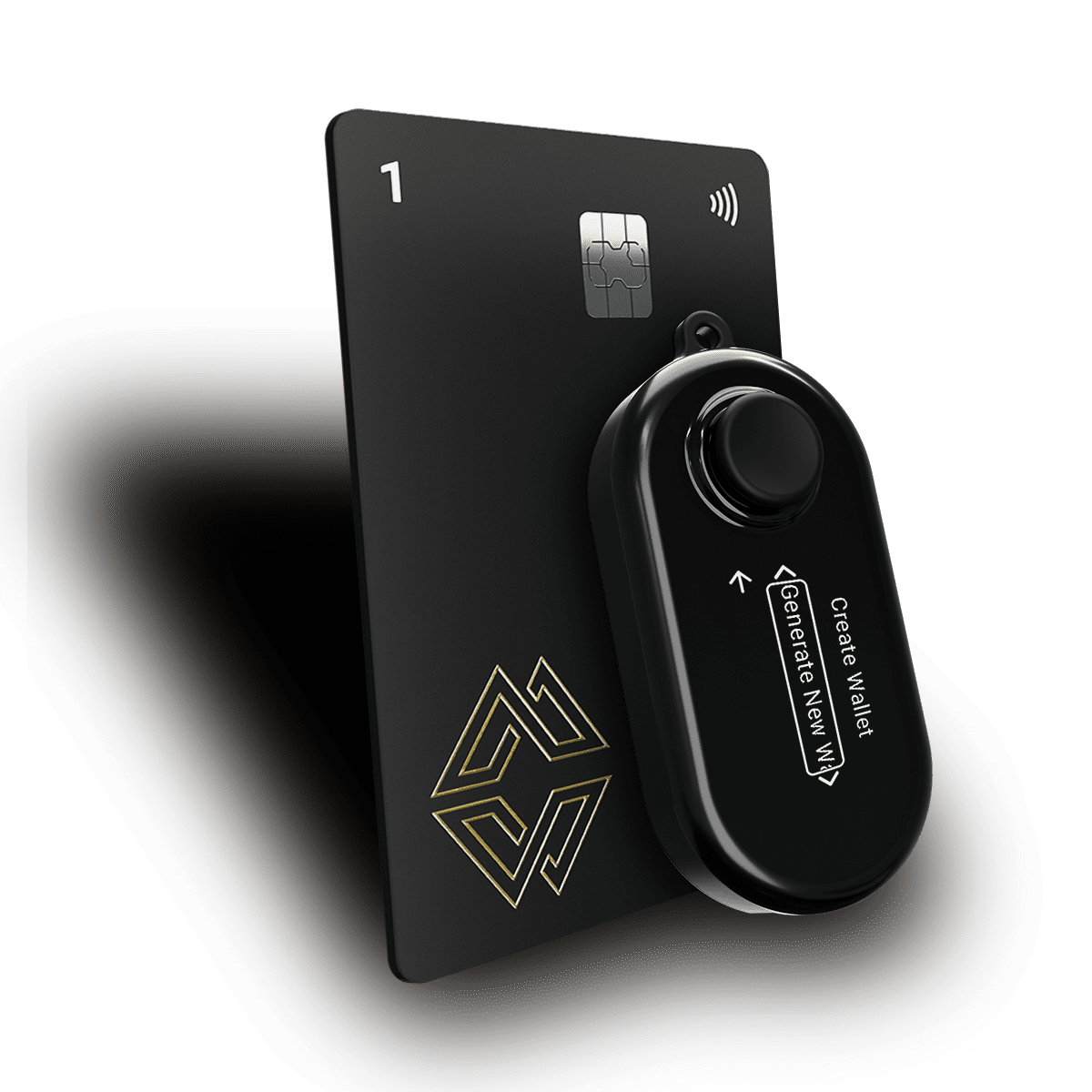
For users who consider this a dealbreaker, the solution exists at the hardware level: a secure display built into the device itself, independent of the phone. Cypherock X1 takes this approach where you verify the transaction's recipient address and amount on the hardware before signing. That's not a convenience feature, it's a fundamental security control.
Tangem's backup system copies the same private key to each card in the set. If you have a 3-card set, all three cards hold identical keys. Compromise one card through physical theft, card cloning, or any future vulnerability in the secure element and all backups are equally compromised. The backup architecture offers redundancy, but it doesn't add security layers.
The more secure approach is to ensure no single device ever holds a complete key in the first place. Cypherock X1 does this using Shamir Secret Sharing, the private key is mathematically split into fragments distributed across five separate devices (one X1 vault and four X1 cards). No single device holds a usable key. A thief would need to physically obtain and combine multiple devices to reconstruct the key and each device is PIN-protected. This architecture fundamentally eliminates the single-point-of-failure problem that Tangem's backup model retains.
Tangem's app is open-source, but the firmware running on the secure chip is not. You cannot independently verify what the hardware is executing. For security-critical infrastructure, closed-source firmware means trusting the manufacturer's claims rather than cryptographic proof.
Cypherock X1 is fully open-source firmware and hardware schematics and has been independently audited by Keylabs and WalletScrutiny. Anyone can review, replicate, and verify the code.
The three limitations above — no on-device screen, shared key backup, and closed-source firmware, each have a direct architectural answer in Cypherock X1. Here's how the two wallets compare across the full feature set.
| Feature | Tangem | Cypherock X1 |
|---|---|---|
| Form factor | NFC card / Ring | Vault + 4 cards |
| On-device screen | ❌ None | ✅ Yes |
| Key storage model | Same key on all backup cards | Shamir shares — no full key on any single device |
| Open-source firmware | ❌ App only | ✅ Fully open-source |
| Independent audit | Kudelski Security | Keylabs + WalletScrutiny |
| Supported tokens | 16,000+ | 19,000+ |
| Seed phrase backup | ❌ Not supported | ✅ Supported |
| Inheritance support | ❌ Not supported | ✅ Supported |
| Entry price | $54.90 (2-card set) | $99 (Basic) |
| Full pricing | Up to $69.90 (3-card set) | Standard $179 / Pro $249 |
Tangem is ideal for users who want a balance between security and simplicity.
If you prefer secure storage without managing seed phrases or complex recovery steps, Tangem fits perfectly.
Tangem is a strong fit for:
Beginners who want cold storage without seed phrase management or complex setup. The three-minute onboarding and no-cable design lower the barrier to entry meaningfully.
Everyday users who prioritize portability. The card and ring form factors fit naturally into daily life without requiring a dedicated device.
Tangem Pay adopters who want to spend USDC from cold storage without a custody handoff, a genuinely novel approach to everyday crypto spending.
Casual holders managing moderate positions across diversified assets, where the primary goal is moving off exchanges rather than hardening against advanced threat models.
Cypherock is the right call when:
You're holding significant value and need every transaction verified on hardware you control, independent of your phone's screen.
You want true key distribution. No single Cypherock device, stolen or compromised in isolation, can yield access to your funds. This is architecturally different from Tangem's backup model.
You require auditable security. Fully open-source firmware means your security posture isn't contingent on trusting a vendor's word, it's verifiable by anyone.
You're thinking about inheritance or delegation. Cypherock's architecture supports structured, secure access delegation without ever exposing a complete key.
At $99 for the Basic tier, the incremental cost over Tangem is modest relative to the security controls it adds. At 4.9/5 across 1,640+ reviews, the real-world experience reflects that.
Requirements: An NFC-enabled smartphone and the Tangem app (iOS or Google Play).
Once set up, the app handles sending, receiving, swapping, and with Tangem Pay, spending directly from cold storage.
Tangem is a well-designed product that genuinely lowers the barrier to cold storage. It's affordable, durable, seed-phrase-free, and in 2026 meaningfully more capable Tangem Pay and Yield Mode add financial utility that most hardware wallets don't approach. For beginners and everyday holders, it's a legitimate upgrade over exchange custody.
The limitations are real, though, and worth understanding before committing. No on-device screen means you cannot independently verify transactions away from your phone which is precisely where sophisticated attacks operate. Shared keys across backup cards means a single compromised card compromises every backup. Closed-source firmware means security assurances rest on trust, not verification.
For users who need more than good enough, dealing with larger holdings, higher threat models, or a preference for auditable and decentralized security — Cypherock X1 addresses each of those gaps directly.
The right wallet depends on what you're protecting and how much risk you can accept. Choose accordingly.
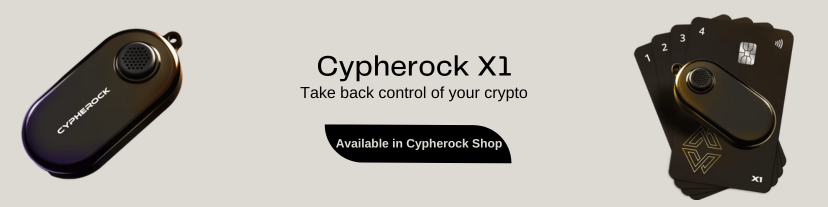
Start securing your crypto journey today—visit Cypherock X1 to learn more.
Connect with us:
Twitter: @CypherockWallet
Telegram: Join the Community