0
$0.00
0 items

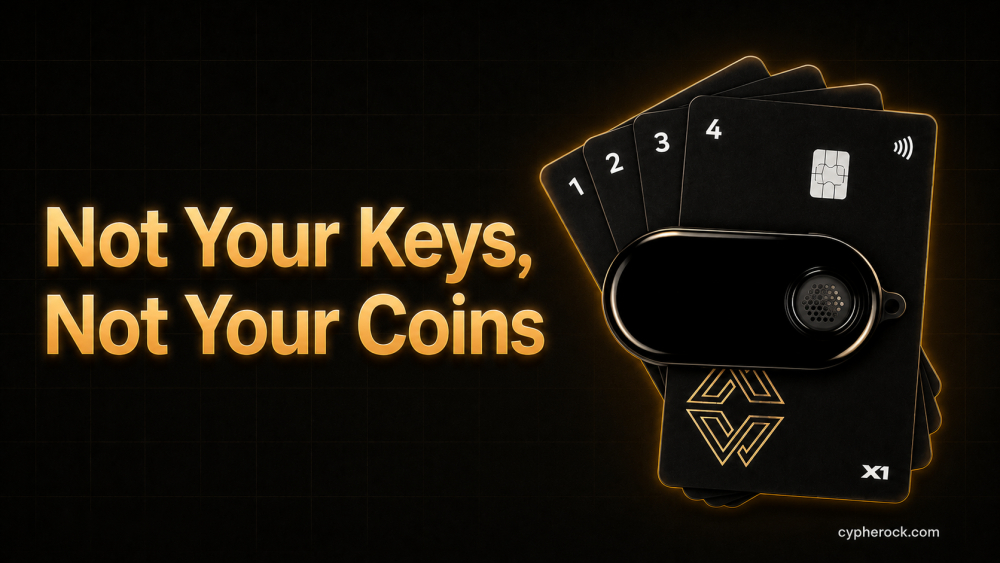
"Not your keys, not your coins." It is the most repeated phrase in crypto. It appears on T-shirts, in Twitter bios, in every post-FTX post-mortem. It is used as a warning, a philosophy, and a rebuke.
Most people who say it have a general sense of what it means: you should move your crypto off exchanges. What most people cannot tell you is why it is true. Not in a "trust me" sense. In a mathematical, cryptographic, provable sense.
That gap matters, because understanding why the phrase is true changes how you approach every custody decision you make. It is the difference between following a rule you've been told and understanding a principle you've internalised.
This blog explains it completely. No jargon assumed. By the end, you will understand what a private key is, why possession of it constitutes ownership of crypto in a way that nothing else does, what happens when you don't have it, and why the logical conclusion of understanding all of this leads to a specific type of hardware architecture.
The first misconception to clear up is the most fundamental one. Crypto wallets do not actually store your coins. They store the private keys that prove ownership of your assets on the blockchain.
Your Bitcoin is not in a Ledger. Your Ethereum is not in MetaMask. Your Solana is not in Phantom. None of your crypto is in any device or application at all. Cryptocurrencies are not held like banknotes in a physical wallet. They live on the blockchain, a public and shared ledger. What you truly own is not the coin itself, but the private key that authorises moving it.
The blockchain is a public record: a ledger that exists simultaneously on thousands of computers around the world. Every Bitcoin transaction ever made is recorded on that ledger. When someone says they "have" Bitcoin, what they mean is: there is an entry on the blockchain showing that a specific address holds a certain number of coins. That entry exists independently of any wallet, any device, and any company.
What a wallet actually does, hardware, software, or otherwise, is store the cryptographic key that allows you to authorise changes to that entry. To move the coins at an address, you need the key. That is all. No account. No password reset. No customer support. The key is the ownership.
A private key is a very large random number. To be precise: a Bitcoin private key is a 256-bit number, a random integer between 1 and approximately 10^77. For context, the number of atoms in the observable universe is estimated at around 10^80. Your private key is a random number almost as large as the count of every atom in existence.
This number is generated randomly by your wallet software or hardware at setup. It is then encoded into various human-readable formats, often as a 64-character hexadecimal string, or as a 12 or 24-word seed phrase that can be used to reconstruct it.
From that private key, your wallet derives:
he private key is the secret. The public key and address are public. The one-way relationship between them, derivable in one direction, not the other, is what makes the system work.
When you want to send crypto, this is what happens mathematically:
Step 1: You create a transaction message. This message specifies: "I want to send X amount from my address to this other address." This is just data — no authority yet.
Step 2: Your wallet signs the transaction with your private key. This is where the private key becomes power. Using elliptic curve digital signature algorithm (ECDSA for Bitcoin and Ethereum, Ed25519 for Solana), your wallet uses your private key to produce a cryptographic signature: a unique mathematical proof that you, the holder of the private key associated with the sending address, authorised this specific transaction.
Step 3: The signed transaction is broadcast to the network. Every node on the blockchain network receives your transaction and its signature.
Step 4: Nodes verify the signature. Using your public key (which anyone can derive from your address), every node independently verifies that the signature on the transaction was produced by the holder of the corresponding private key. This verification is computationally simple. Forging a signature without the private key is computationally infeasible: it would require solving a mathematical problem that would take longer than the age of the universe with all existing computing power.
Step 5: If verification passes, the transaction is accepted. The blockchain updates the ledger entry for your address. The coins move.
There is no account check. No password comparison. No identity verification. The blockchain does not know your name, your country, or your face. It only evaluates the cryptographic signature. A transaction happens when your crypto wallet uses its private key to sign a transfer. The network verifies that signature and records it permanently. Once confirmed, it cannot be reversed.
This is the core of "not your keys, not your coins."
The blockchain has no way to distinguish between you using your private key and anyone else using your private key. The signature produced by the key is the authorisation. Full stop. Whoever controls it controls the funds. There is no approval step and no help if you try to recover what you've lost.
This means: if you hold the private key, you own the crypto at its associated address, regardless of what any exchange, government, or court says. If you do not hold the private key, you do not own the crypto, regardless of what any dashboard shows, what any company promises, or what any legal document states.
When you log into Coinbase or Kraken, you are accessing an internal database ledger, not the blockchain directly. The exchange shows you a balance, but that balance is an entry in the exchange's internal accounting system, not an entry on the blockchain in your name. The exchange holds the private key to the on-chain address. You hold a claim against the exchange. If the exchange is solvent and cooperative, you can convert that claim into a withdrawal. If it is not, as FTX demonstrated, your claim is that of an unsecured creditor against an insolvent estate.
The difference may seem minimal, but these two wallet types have vastly different approaches to security. A custodial crypto wallet is one whose private keys are held by a third party, typically a centralised exchange. Conversely, a non-custodial wallet requires its owner to manage their own private keys. That difference, who holds the private key, is the entire substance of "not your keys, not your coins." It is not a preference or an ideology. It is a description of how the cryptographic ownership system works.
When a traditional wallet is set up, it generates a private key and then presents you with a seed phrase, typically 12 or 24 common English words. A seed phrase is a human-readable backup of your private keys, usually 12 or 24 words. With it, you, or anyone who possesses it, can restore full access to all the accounts, private keys, and funds derived from that wallet, on any compatible software or hardware wallet.
The seed phrase is not a different thing from the private key. It is the private key, encoded in a human-readable format for backup purposes. The 24 words are a representation of the same secret number that authorises your transactions. This means: whoever has your seed phrase has your private key. Whoever has your private key has your crypto. The chain of equivalence is complete and inescapable. Losing those 12 or 24 words means losing everything, permanently, with no customer support to call and no password reset to click. Anyone who gains access to it can take your funds without the possibility of recovery.
No legitimate service ever needs your seed phrase.
The seed phrase is simultaneously the most important backup mechanism in crypto and the single most dangerous document any crypto holder creates. Every phishing attack, every social engineering scheme, every fake support representative: all of them are ultimately trying to obtain your seed phrase. Because anyone who has those 12 or 24 words has full access to your funds, from anywhere in the world, at any time.
A hardware wallet's job is specific and clearly defined: keep the private key in an offline, physically secure environment, and perform transaction signing inside that environment without ever exposing the key to the internet.
Hardware wallets are the safest way to store significant amounts of crypto, keeping your keys offline and away from hackers. Cold wallets (hardware wallets) are physical devices that store your private keys offline. They sign transactions without exposing your keys to the internet, which makes them significantly more secure.
When you use a hardware wallet:
The private key never travels across USB, never appears on your computer screen, and never touches the internet. Malware on your computer can see the transaction being prepared but cannot extract the key from the hardware device to forge signatures. The key stays offline. Only the signature, the mathematical output of applying the key to the transaction, crosses back to the connected computer.
A hardware wallet is a physical device that allows you to manage your assets while storing your private keys completely offline. Since they store private keys in a chip separate from your internet connection, hardware wallets are better protected from malware and spyware than software wallets.
Understanding what a private key is makes one thing immediately obvious: the seed phrase backup that traditional hardware wallets require is itself a complete representation of the private key. All the security of the hardware device, the offline storage, the secure element, the PIN protection, is only as strong as the security of the seed phrase backup that sits on paper or metal somewhere in the physical world.
The single biggest shift in self-custodial wallets between 2022 and 2026 has been the movement away from the seed phrase as the only recovery option. The architectural question becomes: is there a way to achieve the resilience that a seed phrase backup provides, the ability to recover access even if the primary device is lost or destroyed, without creating a discrete, copyable, stealable document that is itself equivalent to the private key?
The answer is Shamir's Secret Sharing.
Shamir's Secret Sharing (SSS) is a cryptographic technique invented in 1979 that solves a specific mathematical problem: how do you distribute a secret across multiple parties such that any sufficient subset can reconstruct it, but no individual party, and no insufficient subset, reveals anything about the secret?
The mathematical guarantee is unconditional: a single share, or any number of shares below the threshold, provides literally zero information about the original secret. Not "hard to extract." Zero.The mathematics works as follows. If you have a secret number S and want to create a 2-of-5 scheme:
The mathematical guarantee is unconditional: a single share, or any number of shares below the threshold, provides literally zero information about the original secret. Not "hard to extract." Zero.
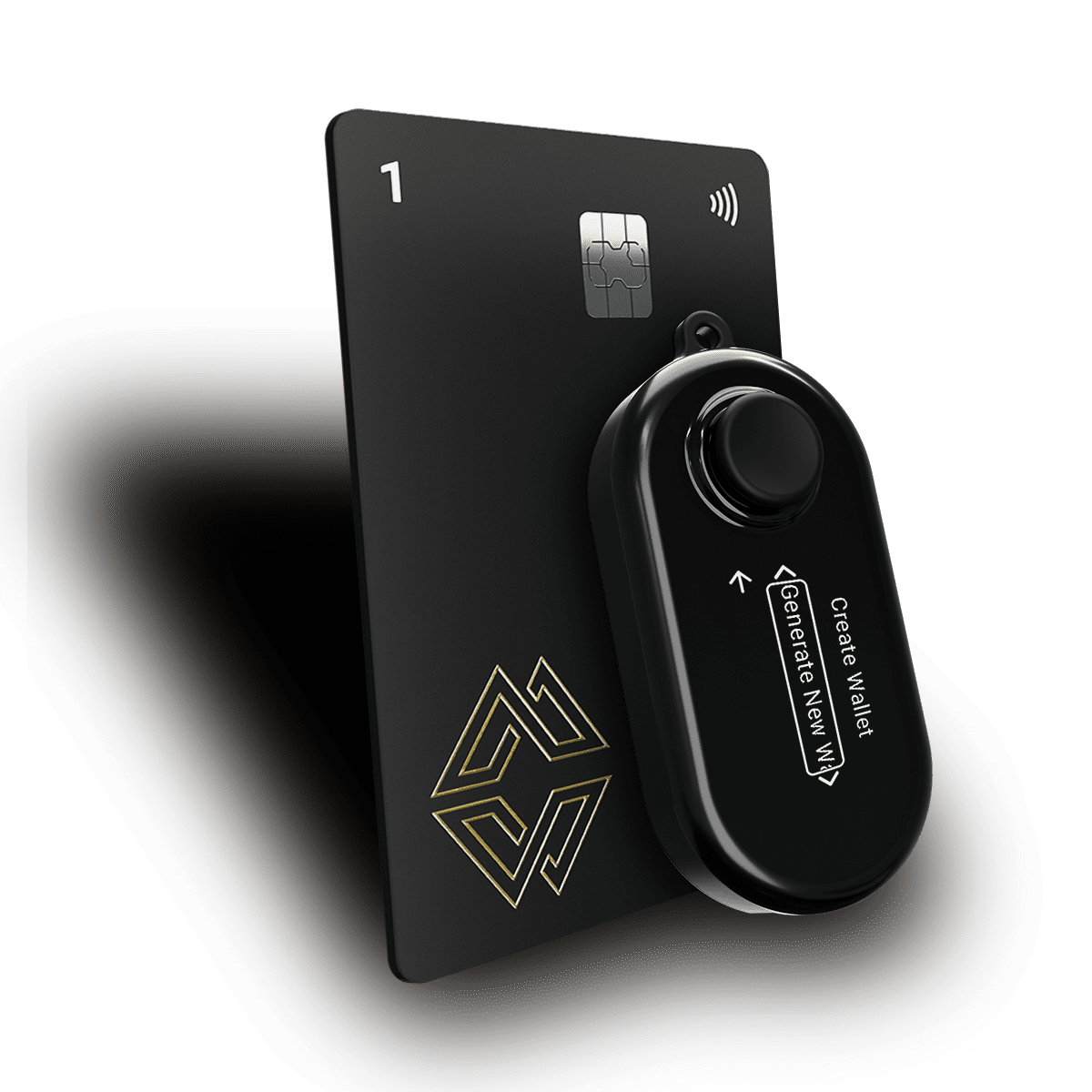
Cypherock X1 applies this to private key management. During wallet setup, the private key is generated on the X1 Vault hardware. It is immediately split into 5 shares using SSS. One share goes to the Vault. One share goes to each of the 4 X1 Cards. The complete private key is never assembled in a single location after this moment. Any 2 of the 5 components reconstruct access. Losing any 3 does not compromise security; you can still access your funds with the remaining 2. Finding any single component reveals nothing about the private key. The SSS guarantee holds unconditionally.
And, crucially, there is no seed phrase vulnerability. No seed phrase backup exists to be stolen, photographed, or found. Any transaction from your wallet requires physical authentication on hardware you hold. The private key exists only as 5 distributed shares on 5 hardware components. It was never assembled as a complete object after creation. There is no paper, no metal plate, no digital file, no sequence of words that represents the complete key. If you choose to view your seed phrase on the X1 Vault screen, you can, but it never leaves the hardware environment unless you decide to write it down.
The attack surface that seed phrase storage creates, the object that every phisher, every social engineer, and every burglar is ultimately trying to reach, does not exist by default.
With all of the above established, here is a clear map of what different custody arrangements actually mean in terms of who holds the private key:
| Custody type | Who holds the key | What you hold | Key risks |
|---|---|---|---|
| Exchange custody (Coinbase, Binance, Kraken) | The exchange | A claim against the exchange | Exchange hacks, insolvency, regulatory freezes, withdrawal restrictions |
| Software wallet (MetaMask, Phantom, Exodus) | You, on an internet-connected device | The private key, in encrypted form on your computer or phone | Malware, phishing, clipboard hijackers, screen capture tools |
| Traditional hardware wallet (Ledger, Trezor) | You, offline on a dedicated secure element | The private key offline; plus a seed phrase backup document | Seed phrase physical theft or loss; the hardware is as secure as the weakest location where the seed phrase exists |
| Distributed hardware wallet that eliminates seed phrase vulnerability (Cypherock X1) | You, across 5 distributed hardware components | Distributed shares; no complete key at any single point | Losing 3 or more components simultaneously across geographically distributed locations |
Exchange custody (Coinbase, Binance, Kraken). The exchange generates and holds the private key. You hold a claim against the exchange. Your "balance" is an accounting entry in their system. Exchange hacks, insolvencies, regulatory freezes, and withdrawal restrictions all affect your access, because your access depends entirely on the exchange's operational status.
Software wallet (MetaMask, Phantom, Exodus). You hold the private key, but on an internet-connected device. The key is stored in encrypted form on your computer or phone. Malware, phishing attacks, clipboard hijackers, and screen capture tools can potentially access the key or the seed phrase from which it is derived. You are your own custodian, with all of the responsibility that entails, but in an environment that is continuously exposed to remote threats.
Traditional hardware wallet (Ledger, Trezor). You hold the private key, offline, on a dedicated secure element. Remote attacks cannot extract the key from the hardware. The remaining vulnerability is the seed phrase backup: a discrete document that, if found or stolen, provides complete access. The hardware is as secure as the physical security of the weakest location where the seed phrase exists.
Distributed hardware wallet that eliminates seed phrase vulnerability (Cypherock X1). You hold distributed shares of the private key across 5 hardware components. No complete key ever exists at any single point. No seed phrase is ever forced into the open or assembled as a stealable backup object. Access requires 2 physical components plus PIN knowledge. No exchange or third party can freeze, seize, or restrict your access. No seed phrase backup exists to be stolen, photographed, or found. This is the logical conclusion of the private key ownership model: maximum cryptographic security with no single point of physical failure.
Understanding private key ownership at this level changes how you evaluate every custody claim you encounter.
When an exchange says "your assets are backed 1:1," you now understand that this means nothing about whether you hold the private key. It means the exchange claims to hold enough Bitcoin to cover all customer balances. The key, and therefore the actual ownership, remains with the exchange.
When a software wallet says "self-custodial," you now understand that self-custody with a seed phrase stored on paper is meaningfully different from self-custody with a distributed hardware architecture. The word "self-custodial" describes who holds the key, not how securely they hold it.
When someone says "hardware wallets are unhackable," you now understand that the hardware wallet itself is highly resistant to remote attacks, but the seed phrase it backs up with is not. The security of the system is the security of its weakest component.
Self-custody means you control your crypto, not a company, a wallet app, or some other platform. When you use self-custody, you're the one holding your private keys, which gives you direct access to your digital assets on the blockchain. But self-custody exists on a spectrum, and the architecture that achieves genuine, resilient, single-point-of-failure-free self-custody is the one that applies the mathematics of SSS to eliminate the seed phrase as a vulnerability.
A government can seize your exchange account, and the exchange's obligation to you, through legal orders to the exchange. It cannot seize crypto held at a private key it does not control. The blockchain does not respond to court orders. What the government can do is compel you to surrender a private key, which is a different matter governed by the legal system of your jurisdiction. Crypto held in self-custody is not impervious to legal authority, but it is not reachable through the same mechanisms that freeze bank accounts.
The blockchain verifies cryptographic signatures, not identities. It has no mechanism for evaluating who the "rightful" owner is beyond the private key. If someone holds your key, the blockchain accepts their signatures. There is no appeals process, no reversal mechanism, and no customer support. This is a design choice: the same property that makes it impossible for exchanges to block your transactions makes it impossible to reverse fraudulent ones.
The security of elliptic curve cryptography relies on the computational difficulty of the Elliptic Curve Discrete Logarithm Problem (ECDLP): given a point on an elliptic curve derived from a base point multiplied by a private key, it is computationally infeasible to determine the private key from the resulting point. "Infeasible" here means that the best known algorithms would require more computational steps than atoms in the observable universe to solve for a 256-bit key. This may change with sufficiently advanced quantum computing, a topic of active research, but is not a practical concern with current technology.
No. The private key is generated and immediately distributed on the X1 Vault hardware during setup. The 5 shares are written to the Vault and 4 Cards. The complete key is never assembled after this initial distribution, not in the Vault, not in cySync, not anywhere. When a transaction requires signing, the SSS reconstruction happens inside the secure elements of the participating components: the reconstruction is temporary, hardware-contained, and produces only the signature as output, not a retrievable complete key.
Quantum computers sufficiently powerful to break ECDSA would represent a fundamental threat to all cryptocurrency systems that rely on it, which is the vast majority of cryptocurrencies currently in existence. This is an active research area, and the crypto industry is aware of it. Post-quantum cryptographic standards are under development. The timeline for a practical quantum threat to ECDSA is debated, with most estimates placing it at a decade or more away from being a practical concern. The self-custody architecture you build today can be migrated to post-quantum standards when those standards mature.
Yes. Every DeFi interaction is a transaction signed by your private key, including token approvals, liquidity provision, and governance votes. When you "connect" a wallet to a DeFi protocol, you are authorising that protocol to present you with transactions to sign. A malicious protocol can present you with a transaction that appears to be a routine interaction but is actually a broad permission grant. Understanding that your signature is irrevocable authorisation, and that the blockchain cannot distinguish between you and someone who has obtained your key, makes the importance of address verification, transaction simulation, and cold/warm wallet separation immediately obvious rather than just abstract advice.
"Not your keys, not your coins" is true in the most rigorous sense available: it is a mathematical statement about how the cryptographic ownership system underlying every major blockchain actually works. The private key is the ownership. Whoever holds it controls the funds, without approval, without permission, without reversibility.
Exchanges that hold your key hold your ownership. Seed phrase backups that represent your key are themselves your ownership. The physical security of a seed phrase is the security of your wealth. Protecting it is protecting everything.
The logical conclusion of understanding this at the mathematical level is to hold your own key, in the most secure architecture available: one where the key is never assembled as a complete, stealable object, where no single physical location compromises everything, and where access resilience comes from cryptographic distribution rather than paper backup.
That architecture exists. It is not complicated to use. And understanding why it works, at the level of polynomials, cryptographic signatures, and one-way mathematical functions, is what separates a holder who is genuinely secure from one who is following rules they have been told without understanding the stakes.
Explore how Cypherock X1 applies Shamir's Secret Sharing to build that architecture, or read our complete setup guide to start from scratch.
Related Reading:-