0
$0.00
0 items

The 24-word recovery phrase has been the foundation of crypto self-custody since BIP-39 was introduced. Write it down, store it somewhere safe, never lose it, never photograph it, never enter it online. For over a decade, that was the standard advice. In 2026, that model is breaking down. Trezor has added Shamir Backup to its flagship devices. Tangem built its entire product line around never generating a seed phrase at all. ZenGo has signed up 1.5 million users with no seed phrase in sight. Vitalik Buterin is publicly pushing for seed phrases to be eliminated at the Ethereum protocol level. And Cypherock X1 has been offering a hardware wallet where seed phrase backup is entirely optional since before any of this became an industry conversation.
This blog explains what is actually changing, how the different approaches work, what each one means for your security, and why the distinction between them matters more than most comparisons acknowledge.
The problem with seed phrases was never the cryptography. BIP-39 is a robust standard. The problem is that it reduces the security of an entire crypto portfolio to a piece of paper or metal that has to be managed perfectly for decades. An estimated 3.79 million Bitcoin have been permanently lost, most of them due to seed phrases that were forgotten, damaged, incorrectly written, or destroyed. Total crypto theft in 2025 reached between $2.78 and $4 billion depending on the reporting source, with seed phrase compromise and phishing among the leading causes.
In early 2026, a critical vulnerability was discovered in MediaTek chipsets, which power approximately 45 percent of Android smartphones globally. Security researchers at Ledger Donjon found the flaw could allow seed phrase extraction from the secure enclave in under 45 seconds through a side-channel attack. The vulnerability was patched, but it demonstrated something important: any architecture where a complete seed phrase exists in one place, even inside supposedly secure hardware, is structurally fragile in a way that distributed key models are not.
The industry has known this for years. The difference in 2026 is that the alternative architectures have matured enough for mainstream adoption and the major players are acting on it.
Not every "no seed phrase" wallet works the same way. There are currently three distinct approaches in the hardware and software wallet market, and they have meaningfully different security properties.
Multi-Party Computation splits the private key into cryptographic shares that must work together to sign a transaction. In ZenGo's model, one share lives on your device and one lives on ZenGo's servers. Neither side alone can authorize a transaction. No seed phrase is ever generated. Recovery is handled through your email address, a biometric face scan, and a cloud-stored backup file.
The track record is strong. ZenGo has reported zero wallet hacks since launching in 2018, and Tether made a strategic investment in the company in 2025. For users who want a mobile-first experience with no seed phrase and no hardware to carry, it is a meaningful security upgrade over traditional hot wallets.
The structural limitation is server dependency. Recovering your wallet requires ZenGo's infrastructure to be available, your email account to be accessible, and the company to continue operating. If any of those conditions are not met when you need them, the recovery path closes. MPC also keeps keys in an internet-connected environment, which means the threat surface is broader than a hardware wallet by design.
Tangem takes a hardware-first approach to eliminating seed phrases. The private key is generated and stored directly on an EAL6+ certified secure chip inside each card. No seed phrase is ever produced. Your phone is simply the interface used to initiate transactions. The key never touches the internet.
Each card in a Tangem set is an independent copy of the same key. If you lose one card, you use another. The simplicity is the appeal: setup takes under three minutes, there is nothing to write down, and the security chip meets the same certification standard used in bank cards and passports.
The tradeoff is the other side of that simplicity. Because each card holds the complete key independently, a stolen card is a meaningful security exposure if the attacker also obtains your PIN. There is no Shamir-style distribution where individual components are cryptographically useless on their own. The recovery model also relies entirely on the physical backup cards. If you lose all of them, there is no recovery path.
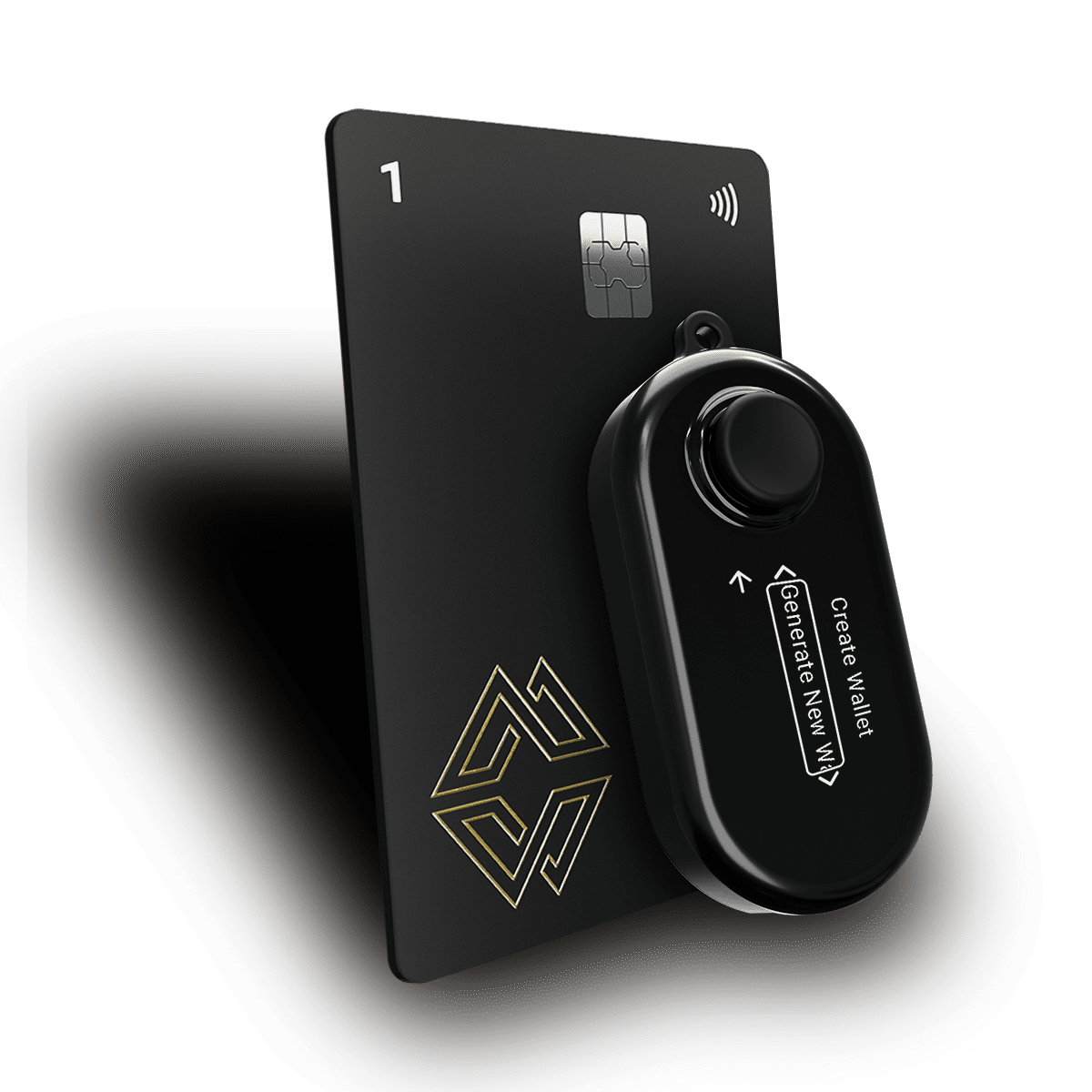
Cypherock X1 takes a different position from both approaches above. It is not a seedless wallet in the strict sense. The X1 is fully BIP-39 compatible, meaning a seed phrase exists and can be viewed or exported by the user at any time. What Cypherock changes is that you are never required to record or store it, because recovery is handled entirely through hardware using Shamir's Secret Sharing.
The private key is split into five components at the entropy level during wallet creation: one stored in the X1 vault device and one in each of four NFC cards. Any two of those five components together can authorize a transaction or restore the wallet. You would need to lose four out of five physical components simultaneously before your funds are at risk. No single component holds the complete key, which means a stolen card or device exposes nothing on its own.
This architecture gives users something neither truly seedless wallets nor traditional hardware wallets can offer. You have the offline cold storage security of a hardware wallet, the distributed resilience of Shamir key splitting, and the interoperability of a standard BIP-39 wallet. If you ever want to migrate to another wallet, you can export your seed phrase and use it on any BIP-39 compatible device. You are never locked into Cypherock's ecosystem. And unlike Tangem, no individual physical component holds the complete key, so physical theft of a single card puts nothing at risk.
Trezor added Shamir Backup (SLIP-39) to the Safe 5 and Safe 3, which allows users to split their recovery phrase into multiple shares using a threshold scheme, such as requiring three out of five shares to restore. It is a genuine improvement over storing a single 24-word phrase in one location.
The key distinction is what is being split. Trezor's Shamir Backup splits the seed phrase itself into shares that must each be physically stored somewhere. The seed phrase exists and the user is responsible for storing the shares. Cypherock splits the private key at the entropy level before a seed phrase is even derived, using Shamir's Secret Sharing across hardware components. The user never has to store anything. The hardware handles recovery without any written material.
Both are more secure than a single paper backup. They are not the same architecture, and for users who want to eliminate the storage burden entirely, Cypherock's model goes further.
Vitalik Buterin has been publicly pushing for the end of seed phrases through account abstraction on Ethereum. EIP-8141, currently expected for 2026 to 2027, would allow wallets to implement social recovery, passkey-based authentication, and multisig at the protocol level, removing the need for seed phrases for Ethereum-based wallets entirely.
This is a signal that the seed phrase era has a defined end date at the protocol level. Wallets that have already moved beyond seed phrase dependency are better positioned for that transition than those where the 24-word phrase remains the primary recovery mechanism.
If you are currently using a Ledger or Trezor without Shamir Backup, or any wallet that issued you a 12 or 24-word recovery phrase as your sole backup, your security model has a single point of failure. That phrase is the complete key to your entire portfolio. One photograph, one flood, one theft, or one fire affecting that backup and your funds are unrecoverable or compromised.
The upgrade path with Cypherock X1 is straightforward. You can import your existing seed phrase into the X1 and secure it using the five-component Shamir system. Your existing wallets remain intact without moving any funds. The paper backup is replaced by a distributed physical key system where no single component holds the complete key, and no written recovery material needs to be stored anywhere.
The hardware wallet industry is moving away from seed phrase dependency through three distinct models: software MPC, card-based seedless storage, and hardware Shamir with no required backup. Each solves the problem differently. MPC offers convenience at the cost of server dependency. Card-based storage eliminates seed phrases but keeps the complete key on each card. Hardware Shamir with no required backup distributes the key across offline components with no written recovery material and no company infrastructure to depend on.
Cypherock X1 is the most mature implementation of the third model. It is BIP-39 compatible, fully audited by Keylabs, open source, and has been built around this architecture since before the rest of the industry started catching up. For anyone who wants hardware-level cold storage without the seed phrase liability, it is the benchmark.
Connect with us:
Twitter: x.com/CypherockWallet
Telegram: t.me/cypherock