0
$0.00
0 items

There's a quiet paradox at the heart of crypto self-custody: the very thing designed to keep you in control of your assets — the seed phrase — is also the thing most likely to get you ruined.
Paper burns. Metal plates get stolen. Memory fails. And one compromised 24-word backup can drain a wallet built over years of disciplined investing.
Shamir's Secret Sharing (SSS) is a decades-old cryptographic principle that solves this problem elegantly. It's also the foundational technology behind the Cypherock X1 — a hardware wallet that doesn't require you to write down a seed phrase at all.
This post explains exactly how Shamir's Secret Sharing works, why it's superior to traditional backup methods, and what it means for the future of self-custody.
Shamir's Secret Sharing is a cryptographic algorithm invented by Israeli mathematician Adi Shamir in 1979. It allows a secret — like a private key or a password — to be split into multiple "shares," where a minimum number of those shares must be combined to reconstruct the original secret.
The core formula is simple to understand conceptually:
This is the "T-of-N" scheme. Even if an attacker steals T−1 shares, they get zero information about the original secret. The math — rooted in polynomial interpolation over finite fields — guarantees this unconditionally.
A common misconception is that cutting a 24-word seed phrase in half and storing each half separately is similar to Shamir's Secret Sharing. It is not — and the difference is critical.
| Approach | Security Property |
| Split seed phrase (12+12) | Each half contains partial information. Both halves are needed, and either half alone reduces the attacker's search space dramatically. |
| Shamir's Secret Sharing | Individual shares contain zero mathematical information about the secret. A T−1 share set is cryptographically useless. |
With a naively split seed phrase, an attacker who finds one half has already cut their brute-force work by 50% or more. With SSS, finding T−1 shares gives them nothing — the mathematics guarantees information-theoretic security.
The Cypherock X1 applies Shamir's Secret Sharing in a way that removes the seed phrase entirely from the user's workflow.
Here's how it works:
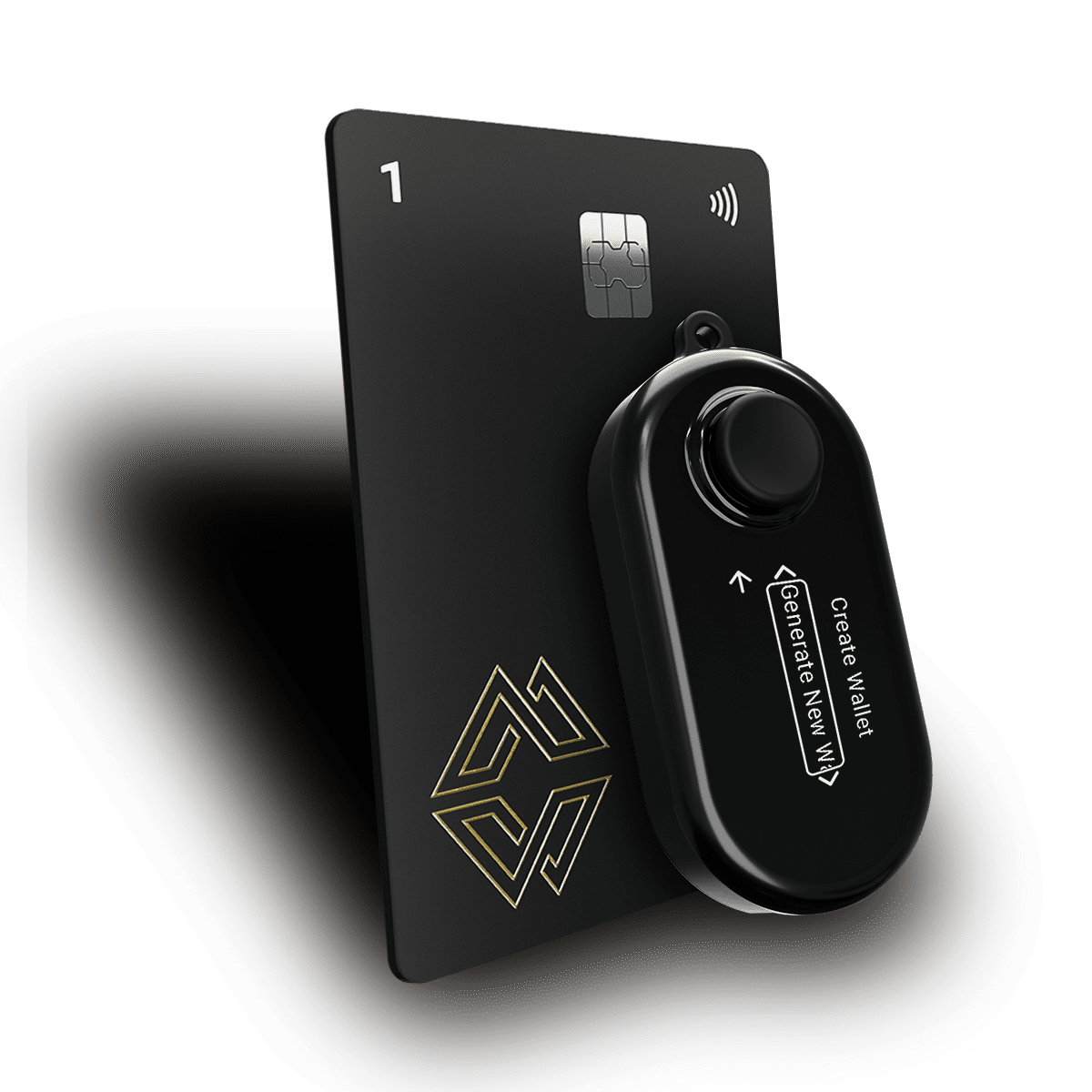
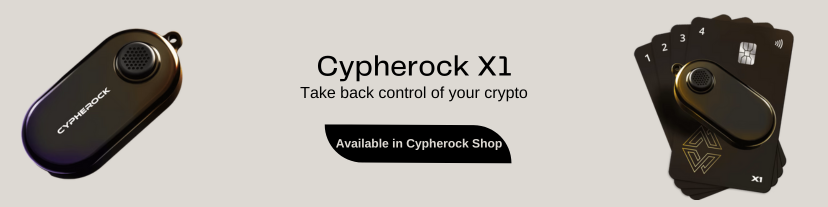
When you set up a wallet, your private key is split into 5 cryptographic shares — 1 stored on the X1 Vault and 4 distributed across the X1 Cards.
Any 2 of 5 shares are sufficient to authorize a transaction. This means:
Since the complete private key never exists in any single location — not on the device, not on paper, not in any backup file — there is no single point of failure. An attacker would need to physically compromise multiple devices, each protected by a separate PIN.
Let's walk through common attack scenarios and how Cypherock's SSS architecture handles each one:
The Vault alone is one share. The thief has 1-of-5 — mathematically useless. Your funds are safe.
As long as 2 of your 5 components survive in different locations, your crypto is recoverable. SSS-based distribution across locations makes geographic redundancy natural.
Using Cypherock Cover, your designated beneficiary can recover access through a structured inheritance flow — without ever needing a seed phrase written on a piece of paper.
The X1 Cards are never upgradable after shipping. Even a compromised X1 Vault firmware cannot extract the keys stored on the cards, since the cards' secure elements are physically isolated.
Many serious crypto holders use multisig wallets (e.g., 2-of-3 Bitcoin multisig) as a way to eliminate single points of failure. Shamir's Secret Sharing solves a related problem but at a different layer:
| Shamir's Secret Sharing | Multisig | |
| Level | Key management (off-chain) | Transaction authorization (on-chain) |
| Chain support | Works for any chain | Varies by chain; Bitcoin multisig ≠ Ethereum multisig |
| Complexity | Transparent to user after setup | Requires managing multiple wallets / cosigners |
| Recovery | Simple threshold reconstruction | Requires all cosigning keys to remain accessible |
Cypherock X1 delivers multisig-level security without the multisig complexity, working across 19,000+ supported tokens regardless of whether the underlying chain supports native multisig.
👉 See also: How Cypherock X1 Works
The 24-word BIP-39 seed phrase was a groundbreaking standard when it emerged. But it was designed for a world where most holders owned one or two assets on one or two chains. Today's crypto user holds tokens across dozens of ecosystems, uses DeFi protocols, holds NFTs, and may have significant wealth at stake.
The threat model has evolved. A piece of paper hasn't. SSS-based key management — as implemented in Cypherock X1 — represents the logical next generation: cryptographically sound, physically distributed, and practically simpler for the end user.
SLIP39 is a standardized implementation of SSS for mnemonic-based wallet backups (used by Trezor's Model T). Cypherock's implementation is deeper — it applies SSS at the hardware level across physical devices, not just to generate backup mnemonics.
If you lose 3 or more of your 5 components (Vault + 4 Cards), recovery becomes impossible without previously established inheritance workflows. This is why Cypherock recommends distributing cards across separate physical locations.
No. The shares are generated on your hardware during setup. Cypherock never receives any share. The system is fully non-custodial.
Yes. SSS operates at the private key layer, which is chain-agnostic. The same security model protects every token in your wallet — from Bitcoin to obscure EVM tokens. Browse the full coin support page.
Shamir's Secret Sharing isn't a new idea — it's a 45-year-old mathematical proof applied to one of crypto's oldest unsolved problems: how do you store a private key without creating a single point of failure?
Cypherock X1 answers that question with hardware. Not with better paper. Not with a metal plate. With a cryptographic architecture that means no single device, no single location, and no single person — including you — can be the reason your crypto is lost.
If you're ready to move beyond the seed phrase, explore the Cypherock X1 or learn about Cypherock Cover for full inheritance and recovery support.
Related reading:
Connect with us:
Twitter: x.com/CypherockWallet
Telegram: t.me/cypherock