0
$0.00
0 items

Every Bitcoin correction brings the same headlines: "Is this the end of crypto?", "Why I sold everything", and the inevitable post-mortem once prices recover.
Most bear market content is about price. When to buy. Whether to DCA. Which assets to accumulate. How to manage your emotions when the portfolio is down 50%.
None of it addresses the thing that actually destroys long-term holders' wealth most reliably: not the bear market itself, but the security mistakes made during it.
Self-custody is critical, especially in turbulent times. In February 2025, the Bybit exchange suffered the largest hack in crypto history, with $1.5 billion in Ethereum stolen even from its cold wallet. While Bybit managed to replenish reserves, this breach sharply exposed the risks of leaving funds on platforms.
Bitcoin peaked at $126,271 in October 2025. As of early 2026, it trades near $67,000, a 47% drawdown stretched across five consecutive negative months. Ethereum is down roughly 65% from its cycle high. Solana has fallen significantly from its highs. If you are holding through this correction, which is the right strategy for long-term conviction holders, the question you should be asking is not when the bottom is. It is whether the assets you plan to hold for the next cycle are actually secure.
This guide is the security checklist that every long-term holder needs to complete before the market recovers. Because the worst time to discover a security gap is when prices are rising and the stakes of losing access are at their highest.
The psychology of a bear market is specific and well-documented. The hardest part of investing in a bear market is not analytical; it is psychological. There are two dominant emotional traps.
The first is the fear of catching a falling knife. The second is FOMO-driven capitulation: an investor holds through the entire decline, loses conviction at the bottom, sells, and then watches the recovery happen without them.
Both traps share the same root cause: attention is consumed entirely by price action. When every hour brings a new headline about what Bitcoin is doing, security, which is slow, unglamorous, and provides no dopamine feedback, gets pushed further down the priority list.
The security neglect that accumulates during a bear market is what creates the losses that happen during the next bull market. Here is the specific pattern:
During the bear market: Holder doesn't move assets off exchange because "prices are low anyway, nothing to steal." Seed phrase backup deteriorates or gets misplaced. Hardware wallet firmware goes unupdated. No inheritance plan is documented.
During the subsequent bull run: Portfolio appreciates significantly. Holder tries to access assets to take some profit. Hardware wallet PIN has been forgotten. Firmware update required before signing. Recovery attempt reveals the seed phrase was stored carelessly. Exchange withdrawal delayed by new KYC requirements. The gains that survived the bear market disappear in the aftermath.
Self-custody strengthens accumulation discipline — long-term holders are less likely to panic when assets remain securely on-chain and accessible at all times. The inverse is equally true: long-term holders who have neglected their security setup are more likely to make panicked decisions when they discover the gap precisely when it matters most.
The following checklist is designed to be completed once, during this bear market, while prices are low and attention is focused, so that the next bull run is about enjoying appreciation, not scrambling to recover access.
Keep only what you need for near-term trades on an exchange; everything else belongs in cold storage. Exchanges can freeze, get hacked, or change terms in a crisis. Proof-of-reserves helps, but it's not a guarantee.
The bear market is the most psychologically comfortable time to complete this migration: prices are low, the urgency of "I need to sell right now" is absent, and you have time to do the setup correctly rather than rushing.
Any asset you intend to hold for more than 30 days has no business being on an exchange. Map every exchange account you hold and identify every position that represents a long-term holding. Move those positions to cold storage before the bear market ends.
Hardware wallets eliminate counterparty risk entirely by keeping your private keys on an air-gapped device that never exposes them to the internet. Whether you hold $500 or $500,000 in crypto, a hardware wallet is the single most effective step you can take to protect your investment.
But not all hardware wallets are equal in their backup architecture. If your current hardware wallet setup requires a 24-word seed phrase stored on paper or metal, you have a backup that is: a single point of failure, vulnerable to physical theft, and dependent on that physical object remaining intact and findable for the entire duration of your holding period.
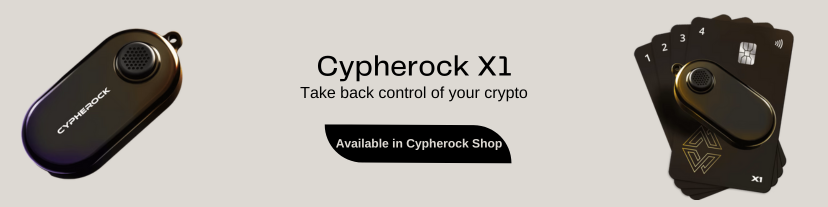
Cypherock X1 eliminates this by distributing your private key across 5 hardware components using Shamir's Secret Sharing. Your seed phrase is split cryptographically the moment it is generated, so you never need to write it down or store it as a paper backup, though you can view the full 24-word phrase on the X1 Vault at any time if you choose. The bear market is the right time to evaluate whether your current backup architecture is adequate for the value you are holding through.
A hardware wallet stored entirely in one location, device and backup cards all in the same home, is a single-location risk. A fire, burglary, or flood that reaches that location compromises your entire setup.
For Cypherock X1 users: your 4 X1 Cards should be stored in at least 2-3 geographically separate locations. Confirm this is still the case. Life changes, moves, relationship changes, safety deposit box closures, can inadvertently consolidate what should be distributed. Review and restore geographic separation.
For other hardware wallet users: seed phrase backups should be in multiple locations. A single metal plate in a home safe is not sufficient for significant holdings.
This sounds trivial. It is not. A PIN used infrequently, as a bear market holder's cold wallet PIN often is, is a PIN at high risk of being forgotten. The longer the bear market, the longer the gap between transactions, and the more likely that a PIN that was memorable in late 2025 is uncertain in mid-2026.
Test your PIN now. Open your hardware wallet and authenticate. If you hesitate, if you have to try more than once, if you have to consult a note: your PIN security is inadequate.
The correct response to a PIN you're unsure of is not to hope you remember it when it matters. It is to use Cypherock Cover's PIN recovery pathway now, while you still have access, rather than after you've been locked out.
A backup that has never been tested is a hypothesis. The only way to confirm a seed phrase backup is correct, and that you can use it to restore access, is to test the recovery process on a separate device in a sandboxed environment.
For most holders, the answer to "when did you last test your recovery process?" is either "never" or "I can't remember." The bear market, when portfolio values are lower and the emotional stakes of a test-run mistake are reduced, is the ideal time to conduct this test.
For Cypherock X1 users: the equivalent test is confirming that each X1 Card authenticates correctly with your Vault using your PIN. cySync has a component verification workflow that confirms each Card is functioning without exposing key material. Run it.
Bear markets aren't only about losses; they often create the best entry points for disciplined investors. They also create unexpected personal crises. Job loss, health events, relationship changes — all are statistically more common during economic downturns, and all can affect your ability to pass on or access your crypto assets.
Cypherock Cover handles two scenarios: PIN recovery (if you forget your PIN) and inheritance (if something happens to you). Both scenarios are more likely to matter during or immediately after a bear market than during the peak of a bull run. Configure it now. Confirm beneficiary designations are current. Ensure your designated contacts know what to do.
Every DeFi interaction leaves a trail of token approvals: permissions granted to smart contracts to move tokens from your address. During a bull market, holders accumulate approvals rapidly as they chase yield, provide liquidity, and interact with new protocols. Many of those protocols are now defunct, abandoned, or unaudited experiments from 2024's hype cycles.
Stale approvals from bear-market-defunct protocols are active security liabilities. If a protocol you approved during the 2025 bull market is later exploited or governance-attacked, outstanding approvals give the attacker access to your tokens.
Use revoke.cash to audit and revoke all stale approvals on your Ethereum, BNB Smart Chain, Avalanche, and Polygon addresses. Do this quarterly — set a reminder now.
Firmware updates during bear markets are easy to deprioritise — you're not making frequent transactions, so the "update required" prompt gets dismissed repeatedly. But firmware updates contain security patches for vulnerabilities discovered since the previous release.
For Cypherock X1 users: the X1 Vault firmware can be updated freely through cySync, and because your private key shares are on your X1 Cards (which are never updatable, a deliberate security feature), a firmware update to the Vault carries zero risk to your key material. Update it.
For other hardware wallets: update firmware carefully, following the manufacturer's guidance, and ensure your backup is verified before any update.
Beyond the self-custody migration audit (Section 1), there is a separate question about exchange accounts you use for trading: are 2FA methods still set up correctly? Are withdrawal whitelists active? Are API keys that were enabled for a trading bot that no longer runs still live?
Turn on app-based 2FA (not SMS), set withdrawal allow-lists, and lock your SIM with a PIN. SMS-based 2FA is vulnerable to SIM swap attacks. If any of your exchange accounts still rely on SMS for 2FA, this is the moment to upgrade to an authenticator app.
The CryptoBandits malware disclosed in June 2026 demonstrated that sophisticated clipboard-monitoring and address-substitution malware is actively circulating on Windows machines. Run a full antivirus scan. Audit browser extensions — remove any that are unnecessary, unrecognised, or installed from unofficial sources. Confirm that the cySync and wallet applications you use are installed from official sources, not from links shared in Discord, Telegram, or email.
A portfolio map is a document recording: every wallet address you hold (public, safe to document), what assets and approximate values each address contains, which device manages each wallet, and where the recovery mechanism for each wallet lives.
It does not contain seed phrases, PINs, or private keys. It contains public addresses and references to where recovery mechanisms are stored separately.
Selling out completely usually comes from fear rather than planning. Instead of making an all-or-nothing decision, many investors find it more sustainable to set clear goals. A current portfolio map is what makes clear goals possible — you cannot evaluate your position or communicate it to an estate executor if you don't have a precise record of what you hold and where.
Update your portfolio map to reflect current holdings. The bear market has likely changed your asset allocation: positions have moved, some may have been consolidated, new assets may have been added. Last year's portfolio map may no longer be accurate.
The portfolio map should be stored in at least two locations: one digital (encrypted, stored offline) and one physical (in a sealed envelope with estate planning documents). It should be shared with your estate attorney and your designated Cypherock Cover beneficiary.
It should not be stored in cloud services, emailed to yourself, or kept in a notes app on a device used for general internet activity.
The data since then has only reinforced the case for self-custody: with $2.37 billion stolen in the first half of 2025 alone, a 66% surge over the same period the prior year, the risk of leaving assets on centralised platforms has never been higher.
The 2026 bear market has reduced nominal portfolio values significantly from their 2025 peaks. But many holders who entered earlier cycles hold assets at much lower cost basis — their portfolio, even at current depressed prices, represents substantial wealth.
Your security architecture should be calibrated to the value you hold, not the value you're watching fluctuate. A holder with $200,000 in crypto at bear market prices needs the same security infrastructure as they did when those assets were worth $400,000, and the same infrastructure they will need when prices recover.
Reassess your threat model honestly:
If any answer is "no," the bear market is the time to upgrade. The cost of upgrading security during a bear market is fixed. The cost of inadequate security discovered during the subsequent bull run is proportional to appreciation.
Public discussion of crypto holdings — on Twitter/X, in LinkedIn profiles, in podcast appearances, at conferences — creates a permanent reference that sophisticated attackers can find. During bull markets, many holders become visibly bullish and publicly identify as significant holders.
During the bear market, audit your public digital footprint. Remove or edit posts that disclose specific holding sizes. Review LinkedIn and professional bios. Consider whether conference appearances or media interviews have made your holdings visible in ways that are now inappropriate for your current security architecture.
Discretion is not paranoia. It is the security measure that eliminates the most dangerous category of attack: the targeted one, before it begins.
Every bear market that has occurred in crypto's history has been followed by a recovery that exceeded the prior peak. Bitcoin has experienced five major bear markets since 2011, with peak-to-trough declines of between 55 and 84%. In every case, patient investors who accumulated during the downturn saw significant gains over the following 12 to 36 months.
The holders who capture that recovery are not necessarily those with the best market timing or the most sophisticated trading strategy. They are the ones who still have access to their assets when the recovery arrives.
The security work described in this checklist takes a few hours to complete and creates a durable foundation that protects your holdings through the remainder of the bear market, through the recovery, and through the subsequent cycle. That is the bear market security dividend: not a guaranteed return on price, but a guaranteed elimination of the most preventable category of loss.
Bear markets are painful, but they are also temporary. By managing risk, diversifying your investments, and resisting emotional decisions, you can survive the downturn and even come out stronger. Use this time to learn, refine your strategy, and position yourself for the next phase of growth.
The security infrastructure is part of that positioning. When the recovery comes, and it always has, the holder who has verified their recovery mechanism, distributed their hardware, configured their inheritance plan, and migrated off exchanges is the one who can act on the appreciation without obstacles.
The holder who discovers their seed phrase is missing, their PIN is forgotten, and their hardware wallet firmware is outdated: in the middle of a bull run, when every hour matters, that is the one who doesn't.
If the full checklist feels overwhelming, here is the minimum viable version: the highest-impact items that can be completed in a single 30-minute session.
Minutes 1-5: Exchange audit. Log into every exchange account. Identify any position held for more than 30 days. Note it for migration.
Minutes 5-10: PIN verification. Authenticate with your hardware wallet. Confirm you know the PIN without hesitation. If uncertain, initiate recovery planning immediately.
Minutes 10-15: Component check. For Cypherock X1: confirm each Card is in its designated location. For other hardware wallets: confirm seed phrase backup is present and readable in its storage location.
Minutes 15-20: Approval revocation. Go to revoke.cash. Connect each DeFi-active address. Revoke approvals from protocols you no longer use or cannot identify.
Minutes 20-25: Firmware check. Open cySync (or Ledger Live / Trezor Suite). Check for available firmware updates. Apply them.
Minutes 25-30: Portfolio map review. Open your portfolio map document. Verify it accurately reflects current holdings and addresses. Update anything that has changed.
Schedule a full checklist review for this time next quarter. Bear markets last longer than the initial panic suggests, and the security foundation built during this one determines the quality of the recovery experienced during the next.
Yes, it is arguably the best time. Migrating assets from one cold storage solution to another involves temporary movement of funds and a period during which you are establishing and testing a new setup. During a bear market, nominal values are lower, urgency is absent, and you have time to do the migration correctly. Migrating during a bull market, when values are high and the pressure to act quickly is intense, introduces the most risk of errors.
This is a financial decision, not a security one: consult a financial advisor for the former. From a pure security perspective, assets in cash in a bank account have zero crypto-specific risk (exchange hacks, smart contract exploits, clipboard malware) but also zero exposure to any recovery. Self-custody in a properly configured hardware wallet allows you to hold your position through the bear market with crypto-specific risks minimised. The security argument for selling to cash is weak; the financial argument depends on your specific situation and conviction.
For Cypherock X1: apply the Vault firmware update without concern — your private key shares are on your X1 Cards, which are never updated, so the Vault firmware update has zero access to your key material. For other hardware wallets: apply updates following the manufacturer's guidance. Verify your backup before applying. The risk of running outdated firmware, which may contain known, publicly disclosed vulnerabilities, is greater than the risk of applying a manufacturer-issued security patch through the official update channel.
The single most common is neglecting the PIN recovery pathway. Long-term holders who make infrequent transactions during a bear market frequently discover, months later, that they are uncertain of their PIN. The resolution, whether through recovery mechanisms like Cypherock Cover or through seed phrase restoration on a new device, is stressful, time-consuming, and in some cases unsuccessful. Test your PIN. Know your recovery pathway. Establish that knowledge now, while access is straightforward, not after it becomes a crisis.
No. Crypto in self-custody at a private key you control is unaffected by market prices, exchange events, or bear market conditions. The blockchain doesn't know about the bear market. Your assets at your address are as secure as your key management architecture makes them, regardless of what the price chart is doing. The bear market's effect on security is behavioural, not technical: it creates the psychological conditions in which security maintenance gets neglected. This checklist is the antidote to that.
Users do not have to leave assets with a centralised institution to participate in lending, trading, or settlement. That has become even more important after repeated failures in centralised crypto markets over the past few years.
The bear market is not a threat to your security. Neglect during the bear market is. The holders who lose funds between now and the next cycle peak will not lose them because the bear market happened. They will lose them because a PIN was forgotten, a seed phrase was found, an exchange froze withdrawals, or a hardware wallet was never set up properly in the first place.
Complete the checklist. Spend the 30 minutes. Move long-term holdings to self-custody so you control the keys. Keep two backups in separate places. Verify your recovery pathway. Configure your inheritance plan.
The market will do what it does. Your security architecture is entirely within your control, and the bear market is the window to build it correctly.
Explore Cypherock X1 for distributed-key cold storage that eliminates seed phrase vulnerability — the hardware wallet built for long-term holders. Check the full supported coin list and set up Cypherock Cover to complete your security and inheritance setup before the next cycle begins.
Related Reading:-