0
$0.00
0 items

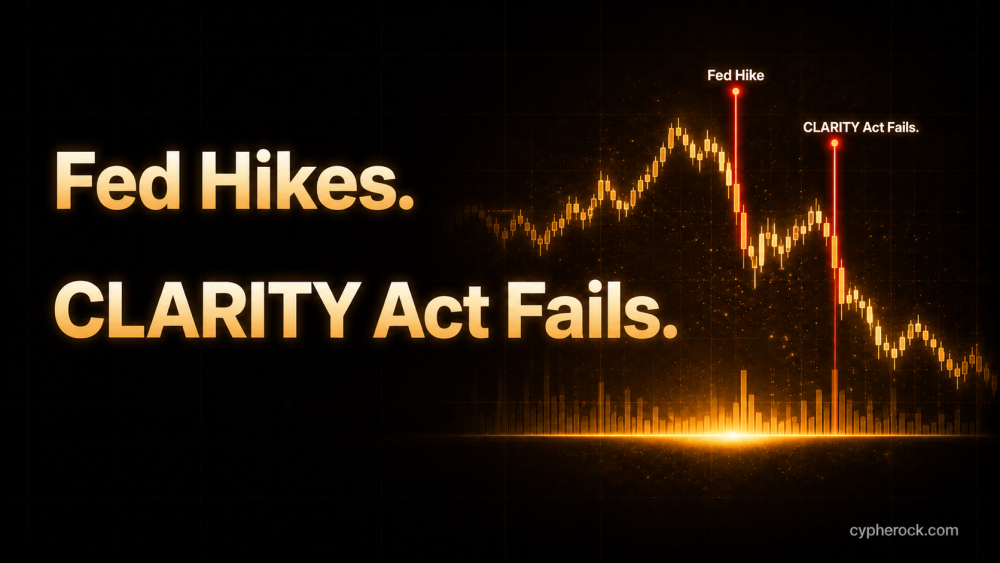
September 17, 2026 delivered two blows to the crypto market in the same afternoon. The Fed raised rates 25bps to 3.75%-4.00%, with 16 of 18 officials projecting at least one more hike in 2026. The CLARITY Act's failure essentially ends market structure legislative work in the Senate for 2026, a major blow to the crypto industry, which has invested years and hundreds of millions of dollars trying to support its interests. Bitcoin is at $76,199. The Fear & Greed Index sits at 50, Neutral.
A 25-basis-point hike had largely been priced in; the real surprise was the Fed's clearly more hawkish stance on further tightening. The latest dot plot showed that 16 of 18 officials who submitted projections expect at least one more rate hike this year. Two macro earthquakes. One day. Every exchange dashboard is flashing red and every crypto newsletter is running emergency editions.
Here is the question nobody is asking in real time: which of your assets are actually affected by today's events, and which ones aren't? The answer depends entirely on one thing: whether you hold the private key.
Rate hikes hurt risk assets. This is well understood. Higher rates make bonds more attractive relative to equities and speculative assets. They tighten credit conditions, reduce leveraged positions, and create selling pressure across everything from tech stocks to Bitcoin. ETF flows, Treasury yields, the dollar, and the Fed's projections provide a more immediate read on market conditions. Today's surprise hawkish dot plot, not just the hike itself but the signal that more are coming, is what moved markets. Uncertainty extending into Q4 2026 creates the worst environment for speculative positioning.
For holders of crypto on centralised exchanges, the rate hike has a compounding effect: not only does it pressure prices, but higher rates increase the financial stress on leveraged exchange positions, reduce the yield differential that makes exchange staking products competitive, and increase the probability of liquidity events at overleveraged platforms. The Bybit hack and FTX collapse both had macro stress as a contributing context. Rate-tightening cycles are when platform vulnerabilities surface.
For self-custody hardware wallet holders, the rate hike affects price, and only price. The private key stored in a Cypherock X1 distributed across five hardware components does not become less secure because the Fed raised rates by 25 basis points. The on-chain Bitcoin at your address does not become less accessible. No liquidity event at any exchange touches it. The price may fall; the asset remains yours.
SEC Chair Atkins said the agency will act on crypto regulation with or without the CLARITY Act, using its existing statutory authority. CFTC Chairman Mike Selig said the agency is locked in and ready to ship new crypto rules despite the Senate CLARITY Act setback.
This is the part of today's CLARITY Act failure that most holders are misreading. The death of the bill does not mean the death of crypto regulation. It means crypto regulation continues, but without the clear, industry-negotiated framework the CLARITY Act would have provided. The SEC and CFTC will regulate using existing authority, applying frameworks designed for traditional securities and commodities markets to assets those frameworks were never designed for.
For exchanges and custodians, this is genuinely damaging. Operating without a clear legal framework means continued enforcement risk, continued compliance uncertainty, and continued reluctance from institutional capital that requires regulatory clarity before deploying at scale. The House Financial Services Committee advanced the American Reserve Modernization Act to codify Trump's plan for a permanent Bitcoin reserve in a 28-21 vote. The strategic Bitcoin reserve continues on a separate legislative track, showing that crypto regulation is fracturing into separate legislative pieces rather than a unified framework.
For self-custody holders, the CLARITY Act failure creates a specific positive implication that almost no commentary is noting: regulation without a clear framework targets centralised intermediaries, not private keys. The SEC and CFTC have jurisdictional authority over exchanges, brokers, and custodians. They do not have a clear mechanism to regulate individual holders of private keys conducting on-chain transactions. Without the CLARITY Act's framework, which would have clarified both the obligations on platforms and the safe harbours for individuals, enforcement pressure falls most heavily on exactly the centralised custodians where retail holders store their crypto.
The regulatory environment just became less certain for every exchange. It became no less certain for every self-custody hardware wallet holder.
The Fed hike and the CLARITY Act failure arriving simultaneously is not a coincidence, it is a macro-regulatory environment that has been building since Q2 2026 and crystallised today. If policy signals soften and flows remain durable, the rally could continue; if they deteriorate together, September may become the market's real test. They have deteriorated together, today, in the most visible possible way.
Aave is launching a specialised RWA lending market on Avalanche, letting institutions borrow stablecoins against tokenised financial assets. Institutional DeFi infrastructure is advancing regardless of today's legislative setback. The on-chain economy continues to be built.
In an environment where macro pressure increases exchange stress, regulatory uncertainty increases custodial risk, and the legislative safety net just failed, the only position that is structurally indifferent to all three is self-custody. Not because markets are not volatile. They are, and prices move. But because the specific failure modes that today's events exacerbate, exchange liquidation cascades, regulatory enforcement actions against custodians, institutional withdrawal from unregulated platforms, are precisely the failure modes that private key custody eliminates.
Bitcoin sits at $76,199 with the Fear & Greed Index at 50. This is not a panic moment, neutral sentiment means the market has not yet priced in the full implications of today's dual shock. What happens in the next 24-48 hours as the hawkish dot plot and CLARITY Act failure fully digest will be more revealing than the immediate reaction.
The productive action for any holder with significant assets on exchanges is not to sell, it is to move long-term holdings to self-custody before the next event. Bitcoin's 23% weekly surge into the $80,000 range was its strongest week in more than three years. The assets you hold through this correction will appreciate again. Whether you can access them when they do depends on your custody architecture, not on the Fed, not on the Senate, and not on which exchange you chose.
The Cypherock X1's distributed key architecture, which eliminates seed phrase vulnerability, means your Bitcoin and altcoins sit at blockchain addresses controlled entirely by hardware you hold across geographically separated locations. No Fed decision, no Senate vote, and no exchange enforcement action can reach a private key that exists only on hardware you physically control.
Today is a reminder that macro events and regulatory failures are not rare, they are the normal operating environment of crypto markets. Build your custody architecture for the environment that actually exists.
Related Readings:-